
Msgr. Robert Hugh Benson died a painful death in his early forties, in the year 1914, two months after Pope St. Pius X- for whom Msgr. Benson had great love and admiration. He was born into an accomplished Anglican family from
Msgr. Robert Hugh Benson died a painful death in his early forties, in the year 1914, two months after Pope St. Pius X- for whom Msgr. Benson had great love and admiration. He was born into an accomplished Anglican family from


A Reprint
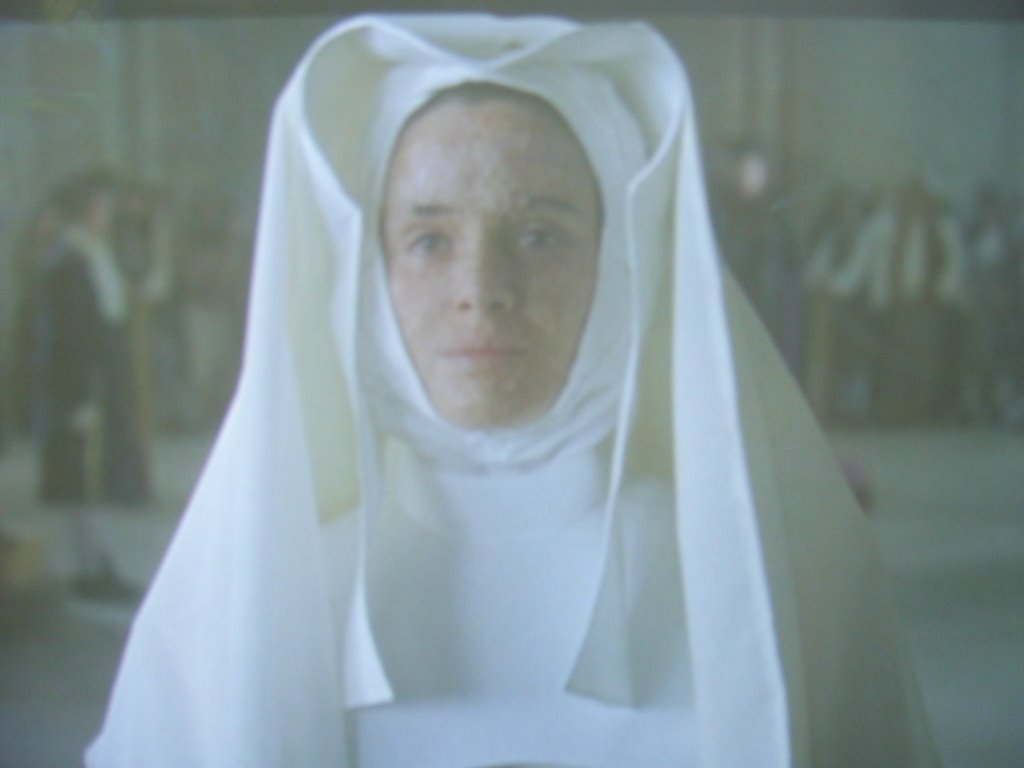
In the movie Therese, there is a very simple but profound scene: a climax, a turning point. It is where St. Therese herself says in A Story of a Soul, “my life was changed, in the time it took to go round the turning of a stair"; it is her passing from one with the will of a child to one with the will of a maturing Christian. It the movie, this change is shown visually as Therese kneels before the crucifix in her room and stretches out her hands in imitation of the small ivory figure nailed to the polished wood.
Therefore, as Mr. Hart argues, the choices for Christians becomes clearer and clearer. One cannot be of the world and be of Christ. It has always been thus, but it seems now that the murky options are clearing away: each rival cultus, from paganism to Islam are being corrupted into the worship of self, or the nothing. This is the meaning of the process of secularization.

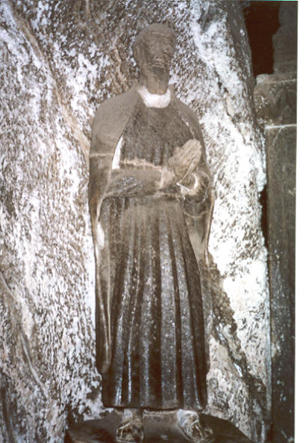
I met St. Edmund on Ender’s
In preparing for this icon, I researched the life of St. Edmund. I felt the hairs stand on my neck as I met the same man in words as I met in spirit on Ender’s
St. Edmund was born in England in 1174, a contemporary of St. Francis of
Blessed are the poor in spirit: for theirs is the kingdom of heaven.
“One might subtract everything else from him — all his gifts of learning and the powers of leadership which carried him from the position of a poor scholar to the Primacy of England — and still, by virtue of those long hours spent night after night in solitude before our Lady's altar, he would remain a saint, retaining what is essential in his character.”
Blessed are the meek: for they shall posses the land.
“Rather he knew that it becomes the servant of the Lord to suffer. "Eadmundum doceat mors mea ne timeat" ran the legend on his seal. It was Becket's martyrdom which pointed to him the true way to victory. He would strive till he could strive no more, yield till he could yield no further without sin, endure to be browbeaten, humiliated, flouted, and disillusioned, and then, since Henry was no tyrant to give him the glory of martyrdom, he chose the humbler self-immolation of retirement.”
Blessed are they who mourn: for they shall be comforted.
“For saints are unaccommodating people, excessively inconvenient to live with in an evil world where Christian principles have to be elastic if they are to square with politics and economic laws...(my sic). We get the impression of a gradually growing sickness of heart, a progressive agony of resistance to forces which he could neither make alliance with nor overrule.
Blessed are they that hunger and thirst after justice: for they shall have their fill.
“As a bishop he stood for the very highest ideals of the churchman ; he is in the true succession of saints of apostolic life who ruled the flock of Christ, not from ambition nor for filthy lucre, but as a true shepherd, ready if need be to lay down his life for the sheep.”
Blessed are the merciful: for they shall obtain mercy.
“When according to the law he received a "heriot"—that is, the best animal from the estate of a deceased tenant — he always listened to the natural complaints of the widow. " My good woman," he would say, speaking to her in English, "this is the law of the land, and custom demands that thy lord should receive the best animal which thy husband had when alive." Then turning to his retinue he would say in French or Latin, "Truly this law was invented by the devil, not by God. After the poor woman has lost her husband, the best thing her dying husband had to leave her is taken away." He would then say to the widow in his mother tongue, "If I lend you the animal, will you take good care of it for me?" Thus the requirements of the laws of man and God were satisfied, at the expense of the archiepiscopal estate.”
Blessed are the clean of heart: for they shall see God.
“He was seen to wash with wine and water the marks of the five wounds on his crucifix, then, making the sign of the cross over these ablutions, he drank them with great devotion saying the words of Isaiah, " Ye shall draw water with joy out of the wells of salvation." His love for the image of the Crucified was notable throughout his life, and in the history of Christian devotions this practice of his was famous in the development of the cultus of the Five Wounds, which finally crystallised into devotion to the Sacred Heart, in which the spear made the chiefest of the wounds of Christ.”
Blessed are the peacemakers: for they shall be called the children of God.
“We too need scholarship allied to sanctity, and our generation, like his, is overwhelmed with an access of fresh knowledge which requires to be assimilated by religious thought, and is assailed by an epidemic of unbelief which only doctors of the faith can conquer.”
Blessed are they that suffer persecution for justice's sake, for theirs is the kingdom of heaven.
“The world being what it was, and he possessing the character he did, no other result of his life was possible, for, as has been said, he is one of those whom our Lord sends as lambs into the midst of wolves, and the wolves of his day were hungry and formidable. He may not have combined in equal proportion the protective wisdom of the serpent with the harmlessness of the dove, but no tact or subtlety could have evaded the issues he was called to face.”
St. Edmund of Canterbury, to me, is a saint akin to St. Joseph: a true father, gentle and loving, but never losing sight of the truth. His life gave a perserverant and humble glory to God.



A thirty-something mom who likes classical and Gregorian is an unlikely candidate to connect with a Tool song: but I did. The song is 10,000 Days (Wings Part 2), and it seems to capture, at the root, the feeling one has when understanding finally something of the cost of martyrdom. The creative man behind this song is the son of a
Listen to the tales and romanticize,
How we follow the path of the hero.
Boast about the day when the rivers overrun.
How we rise to the height of our halo.
Listen to the tales as we all rationalize
Our way into the arms of the Savior,
Feigning all the trials and the tribulations;
None of us have actually been there.
Not like you.
Ignorant fibbers in the congregation
Gather around spewing sympathy,
Spare me.
None of them can even hold a candle up to you.
Blinded by choices, hypocrites won't [seek / see].
But, enough about the collective Judas.
Who could deny you were the one who
[would have made it, / illuminated]
You'll have a piece of the divine.
Another layer of rhythmic harmony, in the minor, but higher on the scale and lighter, is added at the the end of this small verse and the song takes a heavenly turn, almost a turn from resentment to hope:
And this little light of mine, the gift you passed on to me;
I'll let it shine to guide you safely on your way,
Your way home ...
In the next section, he speaks about the lights going down- the loss of a suffering servant, those who are marked by their love and patience and fidelity to
Oh, what are they going to do when the lights go down
Without you to guide them all to
What are they going to do when the rivers overrun
Other than tremble incessantly?
High as a wave, but I'll rise on up off the ground.
You [are / were] the light and the way, they'll only read about.
I only pray, [Heaven / God] knows when to lift you out.
Ten thousand days in the fire is long enough, you're going home.
Here the son lets loose the blood-gorged prayer of one who has seen a martyr but as yet does not trust God to take care of her; but understands subliminally both her and his position as penitent and supplicant before the Face of God. I resonate with the cry in the lines, “It’s my time now! Give me my wings!” Although cloaked in demanding language, I find the arching intensity of the music, and the guitar above beginning the melody, the exact representation in music of the intensity of both a martyr’s desire and thirst for God, and the lesser soul’s awe at the work and mystery of the Lord in the life of a suffering soul ascending:
You're the only one who can hold your head up high,
Shake your fists at the gates saying:
"I have come home now!
Fetch me the Spirit, the Son, and the Father.
Tell them their pillar of faith has ascended.
It's time now!
My time now!
Give me my, give me my wings!"
Give me my wings!
You are the light and way, that they will only read about.
Should we all not live, at the deepest levels, in this intensity, and thirst for the Living God? Can we desire something less and be truly human? We can only do this by making the capacity inside ourselves for God, who will then fill us with His torrent. Then we live as martyrs, white and red. A red martyr is one who we are most familiar in story- the ones who gave their lives for
Set as I am in my ways and my arrogance,
Burden of proof tossed upon the believers.
You were the witness, my eyes, my evidence,
Judith Marie, unconditional one.
Daylight dims leaving cold fluorescence.
Difficult to see you in this light.
Please forgive this bold suggestion:
Should you see your Maker's face tonight,
Look Him in the eye, look Him in the eye, and tell Him:
I never lived a lie, never took a life, but surely saved one.
Hallelujah, it's time for you to bring me home.
A white martyr, like the priest-saint who gave his life-blood to hear confessions many hours a day for many years; the nun who desired to die a thousand martyrdoms-and did so all within the pastoral walls of her convent in the daily giving over of her will to Love; the woman who prayed her husband and her children into sanctity at great loneliness and cost to her own dignity- the list goes on and on. We read these stories with some tremulousness and awe, but at a certain distance, as if a wall of glass separates us from these silent sacrifices of love, these heroic sacrifices. Only when we begin to desire to have the capacity for the love of God does He begin, gently, and perfectly contoured to our weaknesses, show us the immensity of any martyrdom; that death is death- of the self or the body. But no martyrdom is true that is not born of –simply, love- and love at an intensity that 10,000 Days portrays. It is that pounding thirst of the doe at the stream, the hunger of

 A Reprint