Wednesday, October 26, 2005

The Landscape of Traditionalism: Part Three


What part of the living Christ is the Mass? As each Sacrament is a point at which divine grace flows into human life, the Mass is the juxtaposition wherein the Eternal meets the external, where Divinity meets ordinary matter. “The Bread I give you is life for the world” – here Our Lord was talking about the inimitable role of the Eucharist. The Mass is like a spring, life flowing up and spreading throughout the whole Body. Its importance and centrality to the Church cannot be overestimated. As the great Jewish scholar Levinas once described the Sanhedrin as the the navel of the universe, so Christ fulfills and supersedes the Sanhedrin, Himself becoming and remaining the Divine and human navel of the universe. It is the renewal of Christ’s life-giving sacrifice on Calvary; and I use the word renewal, or remembrance, as the Hebrews used it in relation to the Passover: that participation in this mystery places the participant within the eternal now, so that we are all present at Christ’s sacrifice; and not only that, He Himself nourishes us, body and soul, with Himself: as He promised His disciples. The sacrifice on Calvary is thus historically, mystically and truly, the center point of creation.

Protestants and protestantized Catholics have an inherent distaste for the particular-ness of the Sacraments, especially the Holy Eucharist. “Christ, Body and Soul, in a piece of bread? How-how primitive!” they will think. This is the same reaction many of Christ’s followers among the Jews had when He gave his sermon on the Bread of Life. Yet He didn’t explain their “confusion” away: instead, He repeated Himself more explicitly: “My flesh is flesh indeed”. Yet the particular-ness of an Incarnate God, the particular-ness of the Holy Eucharist made present at the Holy Mass are one and the same. Our Lord does not become a piece of bread: rather, the piece of bread, its substance, is changed into Christ Himself, only under the appearance of bread and wine. For sure, this scandal of particularity is a stumbling block for many, as Christ said He would be; but think, for a minute, how great a God would have to be to be so particular, so close to every detail of every life, close enough to know how many hairs are on your head at a given moment, to know each joy and sorrow of each soul, and yet be over and above everything: a Creator who is constantly creative, so large that He can be so small as to tickle a baby’s feet in the womb. The scandal of particularity is not really a scandal when one realizes how great and large one must be to be truly small for each person.

Such is Christ: and such is He most visibly, most especially, in the Eucharist. There He is at His most humble and vulnerable: and so there we must give Him the most honor, reverence, attention and tenderness. And yet, in God’s kingdom, there is He the greatest and most powerful: for He enters into each of us who partake of Him in a very real physical way, miraculously juxtaposed perfectly with the eternal. All of us: our soul, body, mind, heart: all are involved intimately with the Lord at the moment of communion. In this moment everything should help us in the endeavor to see the Lord: the liturgy, music, the symbolism present in each action of the Mass.

How then, can the method and mode, the music and appearance, all the symbolism imbibed almost subconsciously, surrounding this spring of life for God’s Church-how can all these be undervalued or thought as mere accoutrements to be changed like the changing of an outfit?

No. Like all Tradition, the parts of Christ’s continued presence on earth grew organically, carefully, beautifully, as a pearl is covered carefully in layers of oyster’s riches. These growths, from the Holy Scriptures to the Sacraments, to the lives of the saints, the martyrdoms and the marriages, the vestments, the music of Pope St. Gregory, and most importantly, the liturgy of the Holy Sacrifice of the Mass- were carefully tended and pruned, fertilized with the blood of martyrs and the life work of the priests.

Until Henry the VII wanted a divorce. This was the first real stone rolling from the battlements surrounding the Traditions of the Church. Mr. Davies writes eloquently of the process of a Novus Ordo “mass” promulgated not by the Pope, but by Cranmer, the man who was dressing up in the Archbishop of Canterbury's clothes at the time of Henry VII and Elizabeth I. Cranmer formulated a “new order of service” that would “divest the English people of their errors and papistry”- in other words, would change their beliefs. He crafted a series of changes in the service which was once the Holy Sacrifice of the Mass, changes like making the altar “The Lord’s Table” and emphasizing the meal aspect of the service. It was crafted to break the people away from Rome and the Pope, and whether inadvertently or not, it began to destroy the people’s belief in the Real Presence. In Mr. Davies’ book, Cranmer’s Godly Order: The Destruction of Catholicism Through Liturgical Change, the author shows how the liturgy of England’s Anglican faith (pretending to be Catholic) was used as a weapon to destroy the faith of the people. The most important victory for these revolutionaries was won in the destruction of the mass by the destruction of its liturgy. Effectively then, the destruction flowed outward, and the Catholic England that St. Edmund of Canterbury knew was dead.

But Catholic England did not die quietly. Yesterday, October 25, is the commemoration of the English Martyrs: St. Edmund Campion, St. Margaret Clitherow, among many others, died in the defense of Catholic orthopraxis and orthodoxy: but they did not die for dry “ortho” words. They would not have died for the right vestments or an altar, but that these were the vestments worn by Christ’s priests, and for Christ’s altar, those small but eternally significant proofs of His living Presence among us still. They died for Christ in the Eucharist, which is only made possible in the Mass of the Church.

For the Church, England was lost in the wake of the Protestants out in the Channel; hope lied buried there until the flowering of the Oxford Movement at the turn of the 19th-20th centuries- that which gave us Chesterton and Knox, Belloc and Sayers. But in the 16th and 17th centuries, the Counter-Reformation burst out in Europe and the Church, wounded but still strong, rallied to Her Traditions- and the Jesuits were but an example of what was born out of that time. The next time Our Lord’s Church would be seriously wounded, it would be from within the very conclaves of Her citadel.

In 1962, Cardinals, bishops, priests, peritti and even some Protestants marched eagerly into the Vatican for the Second Vatican Council. It was a council called like never before in the history of the Church: not as a council called as a necessary response to a specific threat to faith and morals, but a progressive movement from within the Church Herself, a movement outward to make Herself more understandable to the modern world. But was it a missionary movement? To this question, the answer seems vague. And this is the first sign of danger. However, the traditional schemata were drawn up, documents of clarity and good explanation of the Tradition. As Mr. Davies relates, there was a strange movement among some of the bishops to simply scrap these schemata (which had taken many months to write), and to, in my words, “Go with the flow”. I use this slang because it comes from that time, the optimistic and dreamy early sixties, when the girdles guarding tradition in every sphere were being loosened everywhere and in every institution.

For the Council, then, everything was suddenly out of the traditional ways of handling such a large undertaking, and there was a lot of room for creative action and writing. All of this sounds kind of refreshing and even good to my modern ears, my ears trained in the seventies and eighties in open classrooms. However, within a Tradition: when that which is handed down is part of Christ Himself in the world, creative action and “go with the flow” sounds akin to remaking Christ in one’s own image.

What would happen? Would the Council Fathers work together to protect Tradition whilst becoming missionaries to the world? Would there be a “new springtime”? What would happen if ambiguities and as Mr. Davies puts it “liturgical time bombs” were allowed into the documents approved by the Council Fathers? Was the “smoke of Satan” entering the Church? What would this mean, especially for the jewel in the crown of Tradition, the Holy Mass?

..to be continued

Monday, October 17, 2005

The Landscape of Traditionalism: Part Two


Imagine the Roman Catholic Church not as a building, not as a group of people, but as one of those fancy dessert and sandwich plates one finds only in the Ritz or Plaza Hotels during teatime. Imagine it: a beautiful bone-china plate, delicate, suspended by a decorative metal stand, a rod, bored through the middle of the fine plate. The rod holds the plate aloft, and straight, and the little cucumber sandwiches and miniature pastries are artfully arranged on the surface of the plate. If the rod is defective, the plate will be slanted and defective as an upper-crust tea service: all the cakes and sandwiches will slide off, into the oblivion of the waiter’s table scraper and napkin.

Imagine, though, the rod cannot be, will not be, defective. It is the axis built by God to hold the plate, the visible Church, aloft as a foundation of faith for the members, but also by example, for the world. Now the paint and gilt on the plate may become faded, there may be chips and cracks, but the rod holds it straight and level at the essentials.

What is this rod? It is the Deposit of Faith, it is the Tradition of the Church founded by Our Lord, centered in the person of Peter, or the Papacy. “Where Peter is, there is the Church”. The Papacy is the lodestone of Tradition- it does not encompass it, but rather is its head. As Christ is Head of the Church, His Vicar is Head of Tradition.

So I see that rod, holding that plate, as visibly the purview of the Papacy: not the individual man alone, but that man as holding the Office and with the graces that Office gives him. The farther one is out on that plate, the farther is one from Tradition, from the Papacy as Holder of that Tradition. Thus, there may be people, even the Pope himself (in his private actions, his non-ex-cathedra, non-infallible teaching), who are right at the edge of the plate, leaning toward this or that excess or error, yet still within the confines of still being Catholic and not heretical or apostate. To fall off the plate is to forsake the Papacy and the Tradition the Office guards: and to forsake the Vicar of Christ is to forsake Christ.


But why? It sounds all so medieval, so crafted, so un-abstract, so, so- carnal! How can an office that is necessarily held by a man, how can a bunch of writings and practices and art and whatnot carry the sublime truths of Almighty God? Surely because God is Spirit, He would just go to each individual spiritually, enlightening them, letting the visibilities and practices: the art, the hierarchies of churchmen, the archaic sacraments and sacramentals- be more about the needs of the surrounding culture- that is, a matter of choice?

These questions hit right at the nature of Tradition as it is understood in the Catholic sense- and indeed, hit at the Incarnation of God Himself: for one can level the same criticisms that one levels at a particular-bound Church, to the Person of Christ as He appeared in history.

What is Tradition? It is this question that those who would answer to the (mis) nomer “Traditionalist” are really fighting about: and it is this same question that those who would call themselves “Progressive Catholics” are fighting about. Those ‘middlemen’ who are called now, “Neo-Con Catholic”- I think these find the point of least struggle and go about trying to run the show. But it is interesting that these, the "Neos", who I think believe themselves the most moderate, in the plate image, the closest to the rod of the Papacy in the center, are perhaps closer to the edge because they are focused not on the Papacy, nor Tradition, but rather on the individual man’s idiosyncrasies who holds the office, or perhaps on the political and material advantages in their own nation-states. A hard judgement but I wonder if it is accurate nonetheless.

What is Tradition? What is this rod, this essential foundation? I borrow here from Mr. Davies, and from Father Ripperger’s articles on Tradition in The Latin Mass magazine.

Tradition comes from a Latin word meaning, "what is handed down". This is a general meaning of the word, and can mean anything from family tradition to company policy. These human forms of tradition are what form us in varying ways, they help us to form habits of action and thinking, informing and strengthening the will, which in turn grow the character and virtues (or vices) of a person. A person is not separate completely from the traditions he has been formed within: the concept of radical individuality is really a lie. The differing modes of tradition have different impacts upon a person: that is, familial traditions will be much more powerful than company policy (depending on the company, I suppose). However, it is hubris on our part to think that we are self-made men and women: we are, like candles, formed by the structures and people around us: we always retain our free will, but everything else about us: our temperaments, character, personality, intellect: are unique products of the traditions we have received from others.

Nearly two thousand years ago, Our Lord brought a new entity into existence. It was the extension of His Body, the physical reality of “I am with you always, even unto the end of the world”. It was the birth of Our Lady’s Son renewed, with the sending of God’s Spirit to Mary and the Apostles on Pentecost. Our Lord gave to this new entity Himself, it was meant to spread the reality of God’s Incarnation across all time and space. One has to let this shocking reality set in. God came in a physical Body, and left a physical Body, imbued with the Holy Spirit, in the reality of the Eucharist, but also just as real, in the reality of a Church.

Thus, His Church is not a religious community, nor is it a culture: although it encompasses those characteristics by its nature of having many people within it. The Church is like no other organization in the world, past, present or future: it is the Creator Himself, growing and forming His Incarnation through His children, children of the Church, children of His Mother (“Behold, here is thy Mother”). When we Catholics talk blithely about “The Body of Christ”, we forget that this is a living reality, and not just a symbolic term.

Therefore, anything a part of this Body becomes charged with organic and living meaning: Sacrament, sacramental, liturgy, art and architecture: each is an extension of Christ Himself, as we baptized are. This lays great meaning on each person, each act sanctioned by the Church. God chose these means, able to be grasped by both the senses, the soul and the intellect, because that is how we are made; and as St. Thomas Aquinas teaches, it is through these means that the will is moved and the person is formed.

We are again talking about tradition, what Christ handed down and wished the Apostles to hand down: namely, Himself as a living reality in Scripture, the Magisterial teachings of the Church: the Sacraments, sacramentals; the art, architecture and liturgy; the music and the martyrs and saints- that is, the riches and deposit of Faith as expressed in what has been handed down: Tradition, with a capital “T’. It has a capital “T” because it is part of the living Body of Christ.

Our Lord, therefore, forms us through this extension of His Incarnation. To be a Catholic in the living Tradition of the Church is to be with Christ as Our Lady, St. Joseph and the Apostles were with Christ. This Tradition is the means by which He forms us: as was stated before, none of us becomes what we are with an absence of traditions given us by others. The “nature state” of Hobbes and Locke is pure nonsense. We are born into society, culture, and traditions that form us. The Catholic Church is the culture and tradition of Christ, and is Christ Himself extended over space and time, and encompassing the members of His Body- and founded on another person, the person of Peter and his successors. It is as if Christ handed Himself to Peter, but as an Infant, for Peter to hold- and the Successors of Peter are charged still to guard and care for this Church, these Traditions.


How can anyone, then, take that Tradition into his own hands, even attempt it, in order to remake Christ’s Body into his own image? It is sacrilege. Christ’s Tradition is a beautiful organism flowering and winding its way through the tragedies of human history, using them as stakes on which to grow; changing those very tragedies into triumphs for the salvation of the world. It is the vine to which we must remain attached; for Tradition is the knowable and visible witness for Christ in the world.

Thus is the majestic music, the lives and relics of the saints and martyrs, the soaring testimonials of architecture, the erudite teaching, the missions and missionaries throughout the history of the Church; the billions of Confessions, millions of Holy Orders, Vows and Marriages, and the liturgy as a setting for the Holy Sacrifice of the Mass: thus are these witnesses and realities making present the ineffable Person of Our Savior to the world that needs Him.

Here we must grasp the serious fact that what we do as Catholics, what the hierarchy does, with this Deposit of Faith, this Tradition in its varying and living forms, what the Pope does or does not do- we are in a very real sense, doing to Christ Himself. The rod in the plate on which the very souls and bodies of the faithful rest is a living rod, and we must strive to look to the rod for our reality, our stability: it is the foundation of Faith, reaching through our plane of existence to the beyond.

The next part will discuss the jewel in the crown of Tradition: the Holy Sacrifice of the Mass.

Sunday, October 09, 2005

The Landscape of Traditionalism: Part One


I base my definition of “traditionalist” on Michael Davies. I would guess that he would like simply to be called “Roman Catholic” –I think, to him, “Traditional Roman Catholic” would be an oxymoronic term- or just moronic, for short. Nonetheless, in these days, with so much deep pluralism amongst people calling themselves Catholic, it has become necessary to differentiate with nomers, even if they are missing something of the truth.

After the aggiornomento, or opening up to the world, of the Second Vatican Council, when Mr. Davies was a young man, the winds came into the Church and blew all the furniture about. He came into a Church that was rife with confusion and the rapidity of change, a Church ill equipped to deal with the half-life meltdown that was the Seventies. I saw a video recently of Mr. Davies from this time, on a talk show with the chameleon-like Malachi Martin as host, opposite a high-ranking American prelate. Pope John Paul II had just been elected Pope, and Mr. Davies was arguing in hope and defense of the Pope, who was considered at the least, an unknown, at the best, a ‘traditionalist’. Mr. Davies was arguing also with the American prelate about the promulgation of the Novus Ordae Missae and the perennial nature of the traditional Masses, most notably the Mass which was in use just prior to the Novus Ordae, the Tridentine Mass.

There was great hope in Mr. Davies, his young face serious yet detached, somehow, from the fray. He was unfailingly charitable in his statements, but tough- tough because he argued about present events not from his own light, but in the light of Tradition. That is, he was immersed in the Magisterial teachings, and the history of the Church he loved. It was as if he breathed in the air of Catholic culture and life, from ages past, on many different levels. He had the sensuum Catholicus, the “Catholic Sense”- it is better translated as “ a nose for things truly Catholic”- Mr. Davies was a Catholic Beagle, and I mean that seriously. How many people he alerted to the crisis in the Faith! Even then, in the late seventies, he saw the directions things would take- and I believe he was driven to study history and the Traditions to make sense of it all, and to keep his Faith. In the wake of that drive, he pulled many others to safer waters.

When I met Mr. Davies, in July 1998, he was in his late fifties, and writing his passionate book on the rising of the Vendee in revolutionary France. He was giving lectures to us, and he was in full form, great jokes, the largesse of joy one gets only from real faith in Our Lord; he was likening the rising of the Vendee, against the blasphemous proclamations of the Revolution, to those who would hold to the doctrines and traditions of the Faith in the present darkness. It was my first experience of the war taking place inside the walls of the Church, but I’d sensed it before. Mr. Davies simply cleared it up for me.

I also heard lots of discussions from his corner on a group called SSPX- I thought it sounded like some weird military term from the WWII lessons I’d not paid any attention to in high school. Then I heard the term “Sede Vacantist”- I thought they were talking about some hotel in Italian. Finally, I got curious when I noticed that there was a young seminarian who seemed anxious to talk to Mr. Davies about where to pursue his journey into the priesthood. I sensed that Mr. Davies was like a lighthouse, who not only shed light on things, but also knew the terrain like an old sea captain. Yet he was not conspiratorial or critical of the Pope, the Vatican or anyone else, in a self-serving way. He was not skeptical or critical by nature, but only in necessity, and never out of fear- rather it seemed out of genuine love for the Church. He held to the Church like a beagle to a fox, even if She were hard to find- and encouraged others to do the same.

I began to read his books, starting with I Am With You Always, an explanation of how and in what ways the Lord stays with His Church, how She remains indefectible. It was a lesson from a master teacher in the Traditional Magisterial teachings of the Church: no more, no less. It was not polemic nor a Whiner’s Handbook. It was Catholic teaching, pure and simple.

As a new Catholic, I was-and am- determined that I not become Catholic to become Protestant again, which I feared many so-called “Traditionalists” and “Liberals” had become. So I set myself, in the footsteps of Dr. William Marra, Dietrich von Hildebrand, and mainly Mr. Davies, to understand both the history and teachings of the perennial Church, and the landscape of Her present domain, from end to end. I decided that I loved the Church, like a mother (I love the term “Holy Mother Church”): for She is the ark wherein our souls are formed, where we “work out our salvation in fear and trembling”; and that to love Her is to know Her children, all of them, and then to ask the Lord to show us where He wants us to be His agents.

As a convert of only eight years, I am still a relative outsider, still learning the inexhaustible history and richness of the Church, still learning the depths in the deceptively simple term “Where is Peter, there is the Church”. Yet we must seek, in these days, to know who are those who have submitted to Christ in His Church, and those who have not; and as Michael Davies knew, as a student of history, specifically the history of the Church he loved, we shall know them by their fruits. And we shall only be able to recognize the fruits “in the light of Tradition”.


To be continued-

Tuesday, October 04, 2005

The Landscape of Traditionalism: Introduction


Michael Davies was-and is- one of my heroes. A great Catholic thinker, writer, and activist- all in the package of a humble Welsh schoolteacher. He was full of jokes, good-natured sarcasm and a love of Holy Mother Church and Our Lord.

I have the distinctly odd but happy memory of my husband and I having Mr. Davies with us on our honeymoon- along with many other fine Catholics at the Dietrich von Hildebrand Institute in Italy. Unfortunately, many people have not heard of Mr. Davies, nor read his books on the Faith and the crisis in the Church.

He was a master, and his books are honest, interesting, and humble explanations of both the glories and the modern failures of the institutional Church. He had obviously drunk deeply of the magical British waters, nectar which has produced such great writers; yet he was a real person, he was alive, not like the loads of wax-like figures who are interested primarily in the Church and Her traditions as aesthetic museum pieces. He was a teacher of little children who loved young people; like Our Lord, he surrounded himself with the young and the questioning. He was full of hope and optimism-in God's providence for the Church-not in churchmen. Pope Benedict XVI, as Cardinal Ratzinger, knew Mr. Davies and respected his thought and work in service of the Church.

Yet, again, not many have heard of Michael Davies outside the rather small group included in the larger Catholic world, a group whose focus is the great traditions of the Church with the Latin Mass as a centerpiece. I would like to introduce the landscape of traditional Catholics, but not through my eyes. I hope to do it through the better eyes of Michael Davies- from such sources as my own experiences listening to him, his books, and some of the people who knew him.

The story of traditionalism is fraught with misconceptions, bitterness, and joy.

I hope I can shed light on it in honor of one of my heroes, Mr. Davies.

Friday, September 23, 2005

The Mission of Padre Pio: In honor of his Feast Day


On New Year’s Day, 1903, St. Pio was thinking about his vocation to the Capuchin cloistered life and was feeling apprehensive about leaving the world, his family, and his beloved countryside. Suddenly, he was favored with a vision, not of the imagination, but of the intellect.

We can see things in different ways, and it is said that we can know the angels like we know ideas, although they are persons; they are like living ideas. This is a part of our seeing that we do not exercise enough; we rely too heavily on the physical sense of sight, “Seeing is believing.” But this vision was presented to St. Pio through his intellect: he knew what he saw. And it gave him the answer to his apprehension about his vocation. It was a mandate, a warning, and a promise of aid. This vision was the mean and mode of St. Pio’s life as a priest and monk of God—and his immense suffering. He was permitted a part in protecting and helping weaker souls to attain salvation in Christ.

This vision, which the icon depicts in visual form, was the meaning and the goal that Our Lord planned for Padre Pio, and St. Pio accepted it. It is his acceptance, and the mode and depth of his acceptance, which is one of the great hallmarks in the life of this beloved saint. The Padre’s life was suffused with obedience, for he knew that all obedience, in its proper form, was directed ultimately towards Christ. “If my superior asked me to, I would jump out that window,” he was heard to say. Does this sound like folly? Yes, the Padre was a fool for Christ, and his way of showing that folly was love, to be obedient, obedient when no other would be, to show his love of Our Lord.

From his earliest days, Padre Pio was a docile servant to Our Lord. He did not place his will in any place where it would ever conflict with the Lord’s; therefore, he was freer than the rest of us. It is interesting to note, that he was often charged with disobedience, especially as a young friar, when he was too ill to be at the friary and could only survive, it seemed, in his home area. This was a suffering the Lord allowed him, perhaps to test and strengthen his obedience to the Lord’s will, even at the cost of his superiors accusing him of disobedience. He simply continued to follow orders where it was in his power to do so. And later, when the Holy Office censured him, and even took his spiritual director from him, he expressed sadness but not complaint. This did not mean that he did not see injustice and mistakes; he simply accepted them as from the hand of the Lord, as part of his mission as expressed in the vision.

Obedience is an integral part of the meaning of the vision, because Padre Pio had developed it and been given the virtue in such high degree that his will was malleable for great things by the Lord. For most, the devil we fight is primarily our own wayward will, the desire to put ourselves above what others want for us, primarily the Lord. We will not accept the mysterious will of God because we cannot understand it for ourselves. Padre Pio seemed to forego the need to understand for himself, and he just obeyed. Therefore, the Lord was able to use him to fight Satan himself in order to save other souls.

Obedience was Padre Pio’s crown, which he wears now: obedience and docility to the Lord’s hand, and great love of poor, little souls. Here is the description of his intellectual vision in his own words:

At his side he beheld a majestic man of rare beauty, resplendent as the sun. This man took his hand and said, “Come with me for you must fight a doughty warrior.” He then led him to a vast field where there was a vast multitude. The multitude was divided into two groups. On the one side he saw men of the most beautiful countenance, clad in snow-white garments. On the other. . . he saw men of hideous aspect, dressed in black raiment like so many dark shadows.

Between these two groups of people was a great space in which that soul was placed by his guide. As he gazed intently and with wonder . . . in the midst of the space that divided the two groups, a man appeared, advancing so tall that his very forehead seemed to touch the heavens, while his face seemed to be that of an Ethiopian, so black and horrible it was.

At this point the poor soul was so completely disconcerted that he felt that his life was suspended. This strange personage approached nearer and nearer, and the guide who was beside the soul informed him that he would have to fight with that creature. At these words the poor little soul turned pale, trembled all over and was about to fall to the ground in a faint, so great was his terror.

The guide supported him with one arm until he recovered somewhat from his fright. The soul then turned to his guide and begged him to spare him from the fury of that eerie personage, because he said that the man was so strong that the strength of all men combined would not be sufficient to fell him.

“Your every resistance in vain. You must fight with this man. Take heart. Enter the combat with confidence. Go forth courageously. I shall be with you. In reward for your victory over him I will give you a shining crown to adorn your brow.”

The poor little soul took heart. He entered into combat with the formidable and mysterious being. The attack was ferocious, but with the help of his guide, who never left his side, the soul finally overcame his adversary, threw him to the ground, and forced him to flee.

Then his guide, faithful to his promise, took from beneath his robes a crown of rarest beauty, a beauty that words cannot describe, and placed it on his head. But then he withdrew it again, saying, “I will reserve for you crown even more beautiful if you fight that good fight with the being whom you have just fought. He will continually renew the assault to regain his lost honor. Fight valiantly and do not doubt my aid. Keep your eyes wide open, for that mysterious personage will try to take you by surprise. Do not dear his formidable might, but remember what I have promised you: that I will always be close at hand. And I will always help you so that you will always succeed in conquering him”.

When that mysterious man had been vanquished, all the multitude of men of horrible countenance took to flight with shrieks, curses and deafening cries, while from the other multitude of men came the sound of applause and praise for the splendid man, more radiant than the sun, who had assisted the poor soul so splendidly in the first battle. And so the vision ended.

Wednesday, September 14, 2005

The Search For Solace


We met, once a month, for a year and a half, timidly sipping various coffees at a Borders Café, somewhere inconspicuous, common hairdos in a common strip mall. We were all moms, we never thought of anything more creative to call it than “Mom’s Group”; no one ever looked twice at us, except perhaps when we prayed or when more than one of us came in pregnant, easing into her seat like a ship at dock, heavy with child.

We were surrounded by students with laptops and morbid T-shirts; lonely and obnoxious teenagers and lost young adults. There was no beauty, but there I found solace, and each face around the table became more and more luminescent as the months passed. The beauty came from within, from the laughter, listening, and the occasional outburst and sympathetic tears. Each life, each common mom with common kids, became a mirror for the face of Christ for me; and the light spread around that coffee shop until the ceiling reflected a glow. We had topics, we searched for truth, we talked about the Cross-and the little crosses of each day; we told horror stories of days beyond repair and the eternal meaning encased in each day.

I remember one of us talking about being in heaven, and that we will somehow share a special place with those people we loved especially. We didn’t think of each other at the time, but now, after a year and a half of loving each other, we would now. I was on a search for solace, and the Lord gave me four friends, four common moms, with uncommon souls.

Now I am headed into the sunset, quite literally, to California. So what? Lots of people move. But I know that the Lord sees every life, every event in that life, as quite special. This I know for sure, now, and am glad to have lived long enough to really understand that existentially. And so I know He knows both the gratitude I have for each of those moms, for their husbands and children; for no person gives a gift from solitude- it is always with the foundation provided by others- most fundamentally, Our Lord. And He knows the tears I have on my face now because the daily minutiae matter in a friendship, and I will miss those now. I won’t be on a speakerphone on the Borders table: like a river, life will flow on. But sitting on a grave, as I did on a hot day in July in the middle of a Long Island suburb (my father-in-law’s new grave), will teach you quite forcefully that even in the silence and separation, love goes on. It goes on in a torrent, reaching ever back to its source in God, in eternity.

Am I overdoing it? This is friendship after all: friends come and go. No, I am not overdoing it, as C.S. Lewis bemoaned, friendship is heavily undervalued in modern life. Friends are the solace God gives us in this valley of tears, and the love of friendship, philia, is, like the other loves, meant to be baptized and thus super-naturalized into a higher level, an eternal level. The loves work together: the development of one kind of love is meant to help the growth of the others. In Christian friendship, friendship itself is baptized and begins to draw the other loves in a person’s life into the supernatural, the eternal.

So the common moms at the franchised Borders Café were aiding me in super-naturalizing my whole life. My God bless each person with at least one friend like that. I have been blessed quadrice.

Thursday, September 08, 2005

The Economy of Suffering and Love


I was standing in the vestible of the sanctuary at Immaculate Conception Church. I was annoyed, as is often the case; my blood was pounding in my neck and I was waging an inner war, to offer up the mental suffering and not to be angry at my three-year-old. I had just lost a battle on the inside to anger and on the outside to her will-pushings, and swatted her on the backside. I was going into combat mode, and the Holy Sacrifice about to commence beyond the green padded doors was suddenly in the background, like memory of a green meadow.

Quite suddenly, a woman was beside me, and the battle lifted. She could barely talk; I could see the open hole in her tracheal tube , like a gaping fissure, underneath a clear plastic bandage, all packaged neatly and bravely under the buttoned-up collar of a purple silk blouse. As she gasped and whispered, making my own throat feel sore, I tried to pick out the strong Irish brogue to which I’d been accustomed.

She used to sit behind us in Mass, always alone, but not fearful: a wide-shouldered, rough-toothed, kind-eyed, straight-forward lady. She was the one who said of my little one, “She keeps you running, eh?” And I remember turning round, expecting to see an expression of disdain and annoyance, but instead to find myself folded in life-hardened, but kind peat-green eyes, full of humor. She made me laugh. She made the three-year-old more precious, even if just a tiny bit.

Now here she was, making the tears stream down my face, as her story of surgeries and months in the hospital gushed out. “I wanted to tell you,” she said, and I wondered why-at least, my mind idly wondered, while that deeper part of me, the part which doesn’t use words, understood perfectly. “I almost died three times”, she said. “And I’ll tell you, too, that I saw myself, I was on the cross.” And she put her wide, now bony shoulders forward a bit, and her arms straight out either side. Her purple blouse rippled in response. “ Jesus was holding me, his arms around me; and I could look down and see Mary. ‘See’, says Jesus, ‘you are suffering for Me’.” And she looked up again, and I, with that strange fright of visions, said in a hurry, in order to come back to earth, “ So, you were dreaming?”

She looked at me with those iron eyes. “No, I was in a coma.”

There was something in me that I’m not sure I understand. I felt strange, the strangeness of an Other. Yet I doubted her story, I felt that condescension in me, the kind that says, “oh wow” and “I’m sorry” and then moves on to the next person-that fear of the ‘weird’ the ‘self-deluded’. But I couldn’t turn away, there was something else in me that didn’t care about the strangeness; besides, I was out of energy to respond to the insistence of inhibitions. The tears streamed down my face, because she was in the hospital, suffering on the cross, alone in a coma, and alone in so many other ways. Were there flowers at her bedside? “Oh,” she said, “I hope I didn’t make you cry; because, God is so good. He is so merciful.”

And I and she looked at each other, distant acquaintances, and we conversed without words. So I knew that she came to me, to somehow tell me not to be so angry at my little daughter, that she’d suffered for me in the hospital in a way, and that this was such a great and noble act only because God accepted it- and this meant that He was merciful to her. He accepted her suffering, He was good and kind because her suffering was useful to Him. It wasn’t wasted, or just left as a punishment for her sins: it was transformed. She told me in her humility that none of us escape suffering, because we all deserve it. But God, in His mercy, deigns to use it- for others, even the angry and struggling mother in the vestibule. And I wonder now: are those daily battles, even the ones with three-year-olds, are they such temptations; is my anger and resentment offensive enough to God that they required all this lady’s suffering? “Surely not!” I say, but after all, who am I to be angry? Am I not putting myself in a Judge’s place? Am I not saying, “I don’t like this situation, Lord, You must have put me in the wrong place!” Am I not committing type of sin that Adam and Eve committed?

Who knows how much suffering is required to expiate one act of petty rebellion? Our Lady understood. If I understand, too, how can I stand to sin? Yet, if I also understand my weaknesses, how can I even stand on my feet? Yet as I remember the Irish lady’s eyes, I saw love there. And I remember, too, in that place without words, how, when we are truly immersed in Love, we want to suffer for the beloved. It is a fire, a self-immolation for the sake of the lover: that eros from which is born courage and the forgetting of self. So, perhaps, I, like the choir of angels St. Thomas Aquinas elucidates, the angels who are made solely to receive love, I receive her offering- or rather, I receive the mercy God deigns to give me, out of the Irish lady’s gift of herself.

So let me rejoice with my Irish lady, let me rejoice in God’s mercy to her and to me, let me let the rejoicing stand side by side with the sobered sinner in me, the one who is learning the enormity of each offense. Let me love the traitor in me, the part I keep asking to be burned away. Let me love in truth, let me have clear sight and have the courage to see myself as God sees me, and then let me repent truly and have the gift then not to see myself at all, only You. Like my Irish lady, who is being transformed into You, grant me freedom from fear. And freedom to love. It is a gift. Words are so heavy: no part of me completely understands the economy of love and suffering, but the part without words understands better- like Job, who just put his arms out, threw back his head, and did worship to the Whirlwind- and it ravished him.

Wednesday, August 31, 2005

Finding Our Lady of Walsingham


"But love is a durable fire
In the mind ever burning;
Never sick, never dead, never cold,
From itself never turning." …from a ballad about Our Lady of Walsingham


I go there, to Walsingham, in my mind; you are there with me, walking slowly in your shoes. I have the wheelchair ready just in case you can’t make it more than the forty or so steps you can usually do. You do not know where you are, I have brought you down this road in hopes you will awake, for I stepped into your dreams and I am trying to bring you out. Yours isn't the senility of age, but of darkness. You walk along, slowly, bowed by the many weights of your brokenness, the fear of pain, the carrying of those deeper wounds of the heart: the anger, the loss. The rain is falling but you do not feel it, my friend, heart of my heart. I can’t even speak of it, only to tell you gently that you might feel wet, and a little cold.

Will my Lady warm you? Will you feel her radiant, humble love? Will you see the tiny house, will you know that she has the Lord of the Universe in her lap who will look at you again, at His Mother’s request? She is who will, with her prayers and yours, renew your flesh and your mind. May I be the doormat that allows you to shuffle over and into the Holy House, for I have no more power to heal your hordish suffering than the pebbles we crunch on the road.

I come to Walsingham, in my mind, as it was before the first licks of fire touched the vulnerable wood of the statue and the house, before the gold and Henry’s father’s gifts were taken back by the lesser royalty of later years; before the ancient Priory was chimera-ed into a forlorn, vacant, eyeless, tombstone. I come, seeking that Lady who lives in the little house at Nazareth. I come seeking a woman who had the greatest grace of all: to say "Fiat" to the greatest suffering and the greatest love ever known by humankind, who gave her womb, her womanhood, her dreams, her pain, to God. I come to be present, with you, my friend, to that "Fiat".

As we walk, and you talk about moving on with your life and your plans, not really feeling the drops settling like tears on your middle-aged cheeks, I no longer feel the pebbles and the rain, but rather the fine dust and the heat of a Galilean sunset. I cross over the river in Walsingham, but I see the ancient city wall of Nazareth, traveling the same route as the English river. Up the road, the same road circling under the city and meeting the same main road. You are now riding in the wheelchair, talking about eating more protein and perhaps some fish. I weep anew as I observe your hunched back, the lines etched out from the edges of your eyes by pain’s razor. We turn right, and I see the same main artery of humble human and animal traffic in double vision: one in the blues and browns muted by the desert, the other in the bright blues and browns of a rainy climate. As we travel up through the middle of town, you remark that it seems noisy today and you’d like some quiet. I smile and say, “Why don’t we go in here?” The wheelchair bumps and rocks a bit on the well-used path to the Holy House, and you wince. I put my hand on your shoulder. I look into your eyes, and I say, “I’m so sorry to see you suffer. I love you”. You look at me. I hold your head to my side and you say, with that intensity of yours, “Forever.”

I brought you to Nazareth, to the English Nazareth, because it would be more familiar to your Western eyes, even though you may not be able to see it at all- except, perhaps, in your heart at the end of your life. I brought you to see Our Lady, in the place where she said we would receive her help. I have nothing of my own to give that isn’t tarnished, or cheapened by bad use. But I can bring you to Nazareth, to Walsingham, in the power of love. And I hope you will see its beauty, Our Lady's beauty: for the closer beauty is to truth, the less subjective it is: and the gentle maiden of Nazareth holds Truth on her lap.

As we enter, me clumsy with the wheelchair to the point that you try walking again, as we enter the Holy House, you think you are entering someone’s cute little cottage. But you aren’t. What is inside that House is bigger than everything outside it, as the red lamp testifies.


O gracious Lady glory of Jerusalem

Cypress of Sion and joy of Israel

Rose of Jericho and star of Bethlehem

O glorious Lady our asking not repel
In mercy all women ever thou dost excel
Therefore blessed Lady grant thou thy great grace
To all that thee devoutly visit in this place. Amen.

Richard Pynson, from theBallad of Walsingham

Post Script: When Richeldis de Favereches was about to build the Holy House, she asked for a sign to show her where to start construction. In the morning, there were two dry spots amid the dew-covered ground, each exactly the dimensions of the Nazarene house Richeldis had seen in her dream. She picked one of the spots, but the builders could get nowhere. Richeldis then went back to prayer, for aid, and the next morning the Holy House was standing, finished on the other dry spot. This showed two things: Our Lady’s call to have recourse to prayer in each and every need, and the significance of the geography of the town in relation to Nazareth and the original Holy House of the Annunciation. If one looks carefully at the maps of each town, there are striking similarities. Walsingham is indeed a story in three dimensions.

Friday, August 26, 2005

St. Catherine of Alexandria: Holy Helper of Our Lady


Despites to Holy Deeds: Our Lady of Walsingham, Second Part:

The caravan moved slowly, as all caravans do when the desert wind blows in dry heaves and the light is red behind sand clouds. A young man, leaning his shoulder into the hot air, had just given up peering into the sand for any sign of the foothills and the monastery for which they were headed; but suddenly there was a singing sort of shout, a Bedouin sound, and the young man, Marcion, glanced up to see the walls of St. Catherine’s monastery rearing up in the distance, the massive walls appearing to be covered in blood, the huge sandstone blocks reflecting the dying sunlight; light which moved in slow waves, light filtered through the blowing sand.

Finally, Marcion could hear and see normally. Everything looked so clear inside the walls. He went immediately to the ancient chapel to kneel before the relics of St. Catherine of Alexandria, to help him on his quest to do homage at the places of God here at Mt. Sinai, at Bethlehem, Jerusalem and farthest north, Nazareth. Up above him, he saw the icon of St. Catherine. “She was beautiful”, he thought, and saw the image of the spiked wheel, the palm in her hand, and shuddered. He said outloud, “How could anyone murder such innocence and loveliness?” Marcion turned suddenly, thinking that he heard laughter, not derisive but happily amused, laughter tinkling like many small bells on the hem of a veil. He then remembered her story, and knew why she had laughed at his musings. A picture of her, before her conversion and espousal to Our Lord, came before his imagination. Beautiful, yes, young; heir to a throne and learned beyond many men; she was sought above all other women by the powerful, the wealthy for a bride. She harbored inside, however, a rough-sculptured desire, one, which made her desist from ideas of marriage. In the darkness of her unbaptized soul, she was not able to ascertain clearly why she felt she must find a man who was worthy of her. Finally, in desperation, her mother took her to a hermit high in the desert mountains, a man reputed wise beyond all. He told her of a man beyond her, like the stars are beyond the sands of the desert. She sat before him, yearning for this man to be her husband, caring not about her robes in the dust, receiving from him an icon: a small painting of a lady with a small child on her lap.

Going home, thoughtful, she prayed late into the night, until her head fell on the bed in sleep. She dreamed as if awake, she dreamed of the lady with the child. She recognized in the child’s face the man of whom she’d been told; but He would not look at her after the first quick glance. Stung, she looked pleadingly at His mother. The Mother pleaded with the Child, but He refused, saying, “She is darkness and ugliness. She must learn from My servant on the mountain and be baptized. Then I will accept her as My spouse.” Catherine woke, and as soon as she could, rushed to the hermit, receiving instruction and finally, baptism. She was then favored with another dream of the Lady and the Child, and He put a ring on her finger.

After this, St. Catherine witnessed far and wide to the infinite beauties of her Spouse, and was finally beheaded by the Emperor for her great faith and powers of persuasion regarding her heavenly Spouse. It is said that immediately after her execution, her body was found on Mt. Sinai, where a monastery was built in her honor.

Marcion’s knees were hurting from kneeling for hours on the stone floor of the chapel. He rose, bowed toward St. Catherine’s relics, and asked her intercession for a fruitful pilgrimage up the many steps of the great mountain. He went outside into the starlight. The next morning he rose at dawn; taking off his shoes at the gate leading to the stars, he ascended the mountain as Moses had done, shoeless as Moses had been before the burning bush.

Many months and hundreds of dusty leagues peeled away, and Marcion again found himself thinking of St. Catherine, his patroness; he thought again of the merry laugh, like the tinkling of bells- and a broad smile, full of the joy of a journey’s goal, spread itself across his swarthy pilgrim’s face. He was standing once again outside a place named in St. Catherine’s honor, an hour’s walk from the Church of the Annunciation, the great monastery and Church built over the site of Our Lady’s girlhood home and the place of the Conception of Our Lord. Strange, how the furthermost and last part of his trip should, by necessity, lead him to the place of the Lord’s beginning- in His humanity, that is. Marcion, reminded by the thoughts of St. Catherine and her monastery on the slopes of Mt. Sinai, the many-staired climb to the heights- with no shoes, in acknowledgement of Moses’ taking off of his shoes- he decided that in honor of Our Lord’s Humble Love, Love Who came to such a humble girl in a tiny house built in an insignificant Galilean town, in honor of this, he, Marcion, should do what he intuited that St. Catherine would do: take off his shoes again and walk barefoot the last thousand steps of his long journey. He knelt in front of the little chapel dedicated to his Helper, St. Catherine, and in the same movement downward, began to unlace his strong shoes. He wriggled his feet in the hot, tiny pebbles and fine dust. He smiled again and made his way to the humble house of Nazareth, encased in its great Church.

Ten centuries later, a group of Saxon pilgrims, joined by a growing number of Normans, reached the little chapel that stood about a mile out of Walsingham. It was elegant, and tiny, and built so that on the twenty-fifth of November, the sun would rise directly behind it, lighting the pilgrims’ faces in jewel colors who stood attending Mass. The twenty-fifth of that month was the feast-day of St. Catherine of Alexandria, to whom this little chapel was dedicated. The people, in that very English way of giving everything nicknames, had dubbed St. Catherine’s English chapel (sister to that one outside of Nazareth) “The Slipper Chapel”: in that other English ingenuity, the nickname had two levels: the Old English, Saxon word “Slype” had the connotation of “an in-between place, a stepping off into another world”. That is, The Slipper Chapel, St. Catherine’s, was the final station chapel on the way to Walsingham, and Walsingham, with its Holy House, was another world, another Nazareth, a remembering in the Jewish sense of the word remember: to re-call, to be actually, miraculously, transported to the place of the Annunciation, to learn its lessons afresh as if one were really present with Our Lady at the moment of her fiat; to participate in that humble and trusting “let it be done”; it was the same kind of real “remembering” as the Real Presence in the Holy Sacrifice of the Mass, although of differing degree in the way that only God understands. Thus the Saxon “Slype-er Chapel” was the place where St. Catherine, as a Holy Helper as she was in Nazareth and Mt. Sinai, interceded for the pilgrims to truly journey to Nazareth and to Humble Love, to help from Our Lady at Walsingham.

The more pedestrian meaning of the nickname, “Slipper Chapel” was quite a literal one: it was here that the pilgrims took off their slippers, or shoes, to walk the last mile into England’s Nazareth with bare feet. To feel each step, to feel the gritty and wet English road slowly transform into the pebbly and powder-dust-dry road into Nazareth, to remember our humility before the greatness of God, as Moses had done in taking off his shepherd’s sandals, to learn humility by seeing and knowing the Humility of God in coming to the tiny house as His place of Conception, to the gentle and unknown maiden who would be His Mother.

The pilgrims, like St. Catherine, would come seeking answers, come in need, and leave in love. Like St. Catherine, they would see a child in His Mother’s lap, slightly turned from them, His blessing elsewhere; but with a Mother who smiled and gazed at them, her very posture and gaze an intercession to the reluctant Child.

Saturday, August 20, 2005

Despites to Holy Deeds: Our Lady of Walsingham


“Weep, weep, O Walsingham
whose days are nights,
blessings turned to blasphemies,
Holy deeds to despites.

Sin is where Our Lady sat,
Heaven is turned to hell,
Satan sits where Our Lord did
sway,
Walsingham, oh farewell!"


Sir Phillip Howard wrote these verses shortly after a visit to a tiny English village just off the North Sea in Norfolk; it was the year 1578, and Sir Phillip had been part of the group escorting Queen Elizabeth I. He had seen, probably for the first time, the devastation of the spiritual heart of England, shown here physically in this little hamlet: the empty spot where the Holy House once stood encased in its gold-and-jewel inlaid stone protection; the ancient Priory in slow decay, taken from the careful hands of the priests and monks and given to friends of the Crown; the Martyr’s Field, where the only priest and a layman to protest the desecration were hung, drawn and quartered; the Slipper Chapel, dedicated to the great saint, Catherine of Alexandria, on its way to being used as a barn.

Sir Phillip wept at the sight- he knew that with the ruin of Walsingham, England herself had been hung, her heart drawn, her spirit quartered. It was a betrayal by those in authority that had known no stopping, no bounds of decency: it was a satanic affront to Our Lady and her Child. The destruction of Walsingham was the destruction of the spiritual life of England: Isle of Saints, bulwark for the Faith- England’s demise was the break in the dam of heresy in the West. From this came the Wars of Religion, the de-stabilization of Christian Europe: and the beginning of the secularization with the Peace of Westphalia. England’s fall was the rocket-rise of Protestantism, for she was a place of fervent faith, depth of learning and spirituality; the British Isles were the flower of Christendom, so much so, that England was named, “Our Lady’s Dowry”. When this flower was plucked and stamped into the ground, her riches both spiritual and material, plundered by those intent upon seeing the destruction of the Church, there was left an unnatural vacuum which brought legion assertions of spiritual and material power in its wake. The organic whole of Christendom was shattered like a tree by an axe.

No, one cannot underestimate too greatly the power and purpose of the holy places in a nation; nor of the importance of each nation to the whole of the Church; like the underestimation of the Stable and the thirty silent years of Nazareth, the few words and quiet of St. Joseph and Our Lady, underestimation of these quiet things misses the essence of Our Lord, His love in humility. Walsingham, for England, and the West, is another possessor of the secret of Nazareth: the “fruitfulness in self-effacement, intimate prayer, immolation, silence” – “quotidie morior”- “I die daily”*, like the grain of wheat that falls to the ground to produce a harvest.

Walsingham is the fertile ground Our Lady picked to be a second Nazareth in a nation her Son knew would be a powerful force in the Church and the world. Like the Holy House of Loreto, a later “opened doorway to heaven”, Our Lady’s Shrine at Walsingham was a mysterious reminder of the center of Christian prayer and apostolic activity, which is self-immolation and humility in love: precisely because it was a doorway into the humble life God chose to live on earth.

In researching the shrine at Walsingham, I found many strange and wonderful synchronicities between Nazareth and Walsingham; it is a story set in three dimensions, for the pilgrim to read, pray, and ponder. In the ensuing parts, I will reveal some of these simple wonders; and try to “read” the live book Our Lady left us at Walsingham. I will relate the history of Walsingham, and finally, why it is laid on my heart to pray for the restoration of the actual Shrine.

In the year 1061 AD, a young and wealthy widow, Richeldis de Fevereches, was living in the little Saxon hamlet of Walsingham, a humble and rather backwater place; in those days, many days journey from London (seventy or so miles). It was five years before the cataclysmic invasion of 1066. This invasion of the Normans bears on the meaning of Walsingham. Before the advent of the French-speaking Normans, Britain’s society was made up of the Old Celts, living in the north and west of the Isles, what is now Wales, Scotland and Ireland; Britons with old Roman blood, and the Saxons, who were the descendents of the Viking raiders of the middle of the first millennium. It was a society evangelized by the likes of St. Augustine of Canterbury, St. David and St. Patrick, and sustained by the monks in their great monasteries, like Venerable Bede. It was a Christian society, but of a rather humble and agricultural stock; there seemed to be an unassuming nature about it, but that all changed when the Normans came. Suddenly the Saxons, who lived in the south and east of England (wherein Walsingham is located) were dispossessed of power and land: this conflict and the pain is immortalized in the stories of Robin Hood and King Richard the Lionhearted; or in Ivanhoe by Sir Walter Scott. The essential nature of the change in England’s society within a relatively short time is evidenced in the profound changes of the language. Suddenly, those in power were French speaking; and English was the lower-class form of communication. As English began to take in the French and become the hybrid that it is today, the words for table food were French: beef, pork- and the words for the corresponding animal on the farm were the old Saxon words: cow, pig. This is profound evidence of the strict class structure of post-Saxon England.

Our Lady came to Richeldis de Fevereches just before the Invasion of 1066, and she took the young widow in spirit to Nazareth, where Our Lady showed her the house of Sts. Anne and Joachim wherein she was greeted by the Angel and conceived, by God’s Spirit, Our Lord in her womb. Richeldis was asked to build a house with these dimensions in an area on her land. The house that was built was not a Jewish house, but rather a humble Saxon dwelling, although with the same dimensions of the house in Nazareth. Why not an exact replica, a Jewish house? Part of the mystery of Walsingham is that perhaps Our Lady wanted to speak somehow to the Saxons, who were about to become the poor, downtrodden, the dispossessed. She chose a backwater hamlet, northwest of the central city, like Nazareth is to Jerusalem; a place out of the way, a place that only those who were truly needy and truly seeking would come. She came to strengthen the faith of those who would, in time, become the spiritual and economic backbone of England.

…to be continued…


* quote from I Believe in Love by Fr. d'Elbee

Wednesday, July 27, 2005

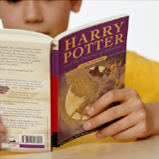
Harry "Postmodern" Potter


The sixth book in the Harry Potter series is out, its themes and subject matter darker and more adult than the previous books. This is no surprise, since Harry is growing up, too; and the debate goes on: is the series bad for our children, for us?

This is a complicated question: we’re not talking about The Gossip Girls series, which is thinly disguised soft-porn tailored to capture young teenage girls; or the Goosebumps series: grotesque, juvenile horror stories- but neither are we talking about the goodness of The Lord of the Rings, The Narnia Chronicles, or The Little House on the Prairie books. Instead, we are talking about a cultural phenomenon, in that these books have taken hold like wildfire, and that they are the first of their kind: postmodern literature for children, with a classical facade. Thus, they are somewhat of an unknown, and in this lies the confusion about whether or not the books are ‘safe’.

No one who reads the books for the sake of the story can deny that JK Rowling is a talented writer, who has created a story that is more than just pure entertainment. She is a master on different levels- from the purely witty and entertaining, to suspense and the real depth of a classical story about good and evil, love in war, friendship and coming of age; heroism and humility, suffering and overcoming hardship. But is it truly classical? I will call it “pseudo-classical, postmodern literature”. In this term is couched the underlying danger of the series to the formation of young minds and hearts.

In order to explore this question of danger, and what it means to be a pseudo-classical, postmodern book, we’ll first go over the basic terms of literature, what makes a classical story, and what differentiates a postmodern book from truly classical literature.

Aristotle’s Poetics describes the very basic and primary elements of all story telling: it is imitation, an activity natural to us from childhood. Stories imitate reality, perhaps not the whole of it, but at least some part of it. Aristotle states that Tragedy represents the nobler, better characters among us, and Comedy represents the baser, lesser characters among us. He says, “Character is that which reveals the moral purpose of the agents- the sort of things that they seek or avoid”; and, “Character gives us qualities, but it is in our actions-what we do- that we are happy or the reverse”. Therefore, it is in the actions of the characters, or the plot, that we discern the real essence of the story, the theme, as it were.

Again, a classical story is made up of some basic elements: subject matter, character, theme and plot. The subject matter is usually part of the setting, in that it is the part of the environment or outer lives of the characters: i.e., the Harry Potter series is basically about young people in England, but within a magical society that is at war. The characters are obviously the people who the author has placed within the setting who will act out the story and drive the plot. The theme is the deeper “about”- and there is usually more than one theme, although there is one that is at the deepest level- it is what ‘end’ the whole story is pointing to, the message at the heart of the work: it drives every other element of the story and gives it its true meaning. Within the plot, there usually lies some kind of introduction (setting up the story for the reader), a build-up, a turning point, and a resolution. Like the themes, there can be a complexity of plotlines, there can even be comedic plotlines alongside tragic ones, but one main plotline, reflecting the main theme, must encompass these. Aristotle describes classical poetry (including any story) as having to have a “whole-ness”, in which no matter how complex, the different plots, characters, settings, themes, must fit together so that none can be lost without radically changing the whole direction. Any element that does not fit tightly is considered superfluous and thus a distraction. The ‘end’ of the story must remain the only end: for instance, in the Narnia series, the end is salvation, which, in turn, points to God as a final end. In The Lord of the Rings, the end is the sacrifice of the noble for the simple, the humility of the greater reaching down in reverence of the lesser in order to love, which in turn leads to the transformation and saving of the good in the world, for the sake of saving lives- and the end of salvation- and again this ‘train of ends’ clearly leads outside to the final end, which is God. I know that I am making a radical statement here, but I stand firmly on the belief that good and true classical literature must lead ultimately back to the Prime Mover, the inexhaustible richness of God.

There may be need here to clarify some concepts, in order to grasp the real problems with Harry Potter. First, Aristotle spoke of imitation, of representing; or presenting again: but imitating, representing what? Reality. A thorough reading of Aristotle, the Physics and the Metaphysics, and his other works of which the Poetics is a part, convinces us that the philosopher saw all of reality as leading toward one Prime Mover, one final end which is also its beginning. Aquinas and Augustine recognized God, the Trinity, in this Prime Mover of Aristotle. Therefore, in a classical and a Catholic sense, all literature must be a representation of reality, a reality that has its final end as the metaphysical, the transcendent, the supernatural. Why? Because the metaphysical realities give meaning and order to the physical, they are the true ordering principles, based in the actions and character of the Prime Mover. Everything flows from Him, and should flow back to Him, in virtue, meaning and order, if it is to be reality. All else is disorder, or a distortion of reality. What is properly tragic, comedic, and dramatic is seen within the framework of the virtues and actions of the metaphysical realities. All else, as I said, is disorder and thus malforms the person who is imbibing the story. I will state unequivocally that for a story to fulfill its true purpose, it must lead back to God in some way, whether explicitly or implicitly: for God IS reality, He encompasses all that is true, good and beautiful; and we are not meant for anything less.

Let us then clarify virtues, in the Aristotelian sense, as well as in the Catholic sense, because they are different. One could say that the Catholic understanding of the virtues (the means toward God, the means toward Order and not Disorder) has been built upon the Aristotelian foundation, correcting it and deepening it. Aristotle spoke of the virtuous man as a man balanced between extremes- a man who was ordered and because of his right balance and order, was thus happy. Happiness, for Aristotle, was not a feeling in the individual in response to some gain, but rather a result of living a balanced life. The Catholic understanding of virtue takes the ordered happiness and fecundates it with the love of God; that balance and order are essential for a man to be able to love well; but the idea that virtues lie in the actions and the will of a person, rather than the feelings or desires, remains a Catholic ideal.

Thus, in a story that follows classical and Christian lines, all the elements of it should lead toward a representation of events and characters that evolve toward order, virtue and love-but love outside oneself, love and happiness as ordered toward love and service of The Good, God; or, as in comedy, to show the foibles involved in less-than-perfect creatures striving towards order and their final end. The transcendent informing and driving the story is absolutely essential to the story being truly ‘classical’ or “Catholic”.

One must look at JK Rowling’s’ six (to be seven or eight) books as parts of a whole story. They cannot stand on their own, thus when discussing her writing, we will be discussing the series as a whole. They revolve around the maturation of a young orphan into a young man who must shoulder the responsibility of heroism and fight the most evil person his society has ever known. The fact that it is a magical, wizarding world is problematic in two ways: one, that young people might be attracted to the unsavory, evil, disordered and stupid world of witches, and ultimately Satanism and the occult. This problem is real and has been discussed ad nauseum. The second way it is problematic is in that can be said to be a representation of unreality and thus fails as a good or classical piece of literature. This is a charge leveled at Tolkein and CS Lewis, and any fantasy writer. However, as in these other, wonderful stories, JK Rowling’s’ magical world has a real-life order of its own: one of the real delights of her books is precisely that she can make the magical, imaginary society so tightly knit, so REAL. She is a bit like Tolkein in this respect. There is a consistency and an order about it that is quite masterful. So, in the end, the magical part of the book is by no means the most unreal: the true disorder of the plot lies somewhere between the main theme and the main plot, the marrow of the stories, and it is here that we find that the story is truly postmodern and not classical or Catholic at all, and that this postmodernism actually deforms the imbibing reader.

Postmodernism is a movement of thought and art, philosophy and religion that is basically anti-foundationalist: that is, it means that there is no real foundation to anything, that it is basically accepting the individual as an independent being in a flux of ‘truths’. Thus, ‘reality’ cannot really be discerned, nor, according to the postmodernist, is it desirable or ‘good’ even to try to discern it. But by what standards do we act, or decide what is good? How do we discern evil and fight it? In postmodernism, it seems that there is a strange boomerang effect back towards the individual: as in the US Supreme Court decisions pertaining to Casey vs. Planned Parenthood and Roe vs. Wade, it is the right of the individual to decide how the moral universe is ordered and how it relates to him (paraphrased). Society is to be a framework that simply guarantees the ability of the individual to build his own moral universe- I suppose, as long as he doesn’t step on the rights of others who can articulate their position. And postmodernism even goes farther: that there is no foundation for anything that a human being can discern as being the true foundation: it is assertion of the failure and demise of the classical and Catholic, even Enlightenment, notions of reason and natural law. Frightening? It should be. It is. Estragon and Vladimir have stopped waiting for Godot and are turning in upon themselves, imploding. It is Nietzsche on psychedelics.

How does Harry Potter fit in with postmodernism? As I said, it is somewhere between the deepest and main theme, and the main plot line that we find the virus of postmodern thought. For the main theme, and the end of the main plot, is about the power of love, love born of a mother’s sacrifice of herself to defend her baby son, to overcome evil; and that this evil cannot understand the simplicity of love, and the power of “an untarnished, pure and whole soul”, because by actions born in selfishness and hatred, this evil has torn itself into a complexity of parts.

Is it apparent here that this theme has a profundity and a depth, and it is this that is grabbing people’s attention. As I said, this story is not teenage flotsam. But if the theme sounds good, and profound, where is the danger? Isn’t it rather a good story, with many powerful lessons for a young population hungry for something of substance? If one is looking with eyes formed in a foundation of truth, one will project that foundation into the story: but if one is coming from no foundation, or confusion, as many kids are, they will read their own emotions, their own perceptions of the moral universe into the book. The story does not give a representation of reality, but instead acts as a vehicle by which the reader can project his own reality.

What makes the book postmodern is that there is no reference to truth, or a reality outside itself. In fact, the ‘real’ world, the world of non-magical Muggles, is seen as comic relief- they are the lesser, baser beings, whose unchangeable position is that of those who are fumbling toward obscurity and blindness. And the magical, higher world has no transcendent reality attached to it. It is truly non-foundational, truly immanentized, truly postmodern. It runs on the ‘traditional’ social paradigms of institutions like school, home, family and work, buses, death and achievement, but there is no direction toward an end outside itself. For the world of Harry Potter, there is no foundation except itself: and thus, each part of the whole is directed at self, at the gaining of a happiness based on the individual’s perception of the universe. Now it seems that JK Rowling, in presenting Harry as the hero, is also presenting his ideas of caring for friends and seeing kindness, charity and loyalty as ends, or goods; this is her own perception of the universe, but she does not seem to be able to make a bridge into the transcendent, thus truly providing the essential ‘metaphysical viewpoint’.

One can see this quite clearly when one compares Harry Potter to The Lord of the Rings. References to a higher order, a transcendental order, a metaphysical reality, are rife, and drive Tolkein’s story, providing an end outside itself, thus grounding it in reality and making it classical and Catholic. Gandalf’s and Galadriel’s pointed remarks to Frodo that “he was meant to have the ring” and “we cannot decide the time in which we were born, but only what we must do with our time”; and Gandalf’s journey into death and then “sent back to fulfill my task” are essential pointers toward the real end of the story. These raise the question: “Who is the Being who ordains, and orders it so that the characters grow in goodness?”

In JK Rowling’s’ story, these questions are never raised. The ends are circular: to the self, the circle of essential others to the self: friends, family, society- but not outward to the Prime Mover. Therefore, the reader is formed unwittingly into a very noble-seeming world of the self- a truly postmodern project. One can begin to see the malformation of characters even within the story itself, even as the author is trying to present Harry and his friends and the great Dumbledore as the virtuous: there are grotesque people within the world, in such horrifying conditions, and yet they are accepted and used as comic relief. There are the ghosts, who haunt the castle and are in a perpetual state of limbo, even retaining the wounds that caused their death (Nearly Headless Nick); and the pitiful Moaning Myrtle, who lives in the sewage pipes of the school. The odd thing is that the characters, who are supposedly the virtuous, seem unconcerned about these lost souls, and there is no transcendental explanation or resolution for their plight. It is as if they are no longer people and so don’t really matter. This is a characteristic of the postmodern, this completely immanent indifference to those outside our immediate understanding, like the unknown, inarticulate child in the womb. All of this is characteristic of the world that has shut out the transcendent, and no longer seeks judgment on its actions from a higher world, from God. This false teleology is what will malform the reader, precisely because stories are meant to teach at the deepest levels, and Harry Potter is a powerful teacher of postmodernism.

Thursday, July 21, 2005

Part Five: Exiles and the Spirit of Elias


I am a Third Culture Kid. This was a term coined for those of us who have lived in different countries as children; those of us who don’t belong wholly to any culture: our parents often have a home, or ‘first culture’ and we have lived in another country or countries as ‘second cultures’. Thus, in the end, we live between cultures, we live in the limbo of the Third Culture: a culture of movement, of fluidity of friends and environments, religion and language, changing taboos and chameleon social expectations.

The term, “Third Culture Kid” is a kind version of a truer term: exile. We are foreigners both abroad and at ‘home’, and often our own parents cannot understand the exile we feel when they are finally, with a sigh of some relief, settling back into their home culture life. The exile for the child is hammered home also in the moves; like a political exile, in an international move, you lose everything: everything. The plates you’ve eaten dinner on, the furniture, the pets, the climate, everything. Often I think you also fall into grave danger of losing any religion, because for all of us, but especially for children, the acquisition and deepening of faith is deeply connected to the physical environment and culture in which it is first received.

I have, all my life, felt the grief, the deep and unnamed sorrow of the exile. I have felt like I lived in a desert which was only peopled by the things and memories I could somehow smuggle out of the places I’d left. I have also felt guilty for this sorrow, because after all, I was privileged enough to see so many good things, from the lapis-laden ruins of Khandahar to the salt-bleached temples of Delphi and Corinth. I played happily all day in the crystalline waters around the islands of Greece and camped across Europe. No, I would not trade those things. But since my return to my parents’ home culture, I have been in exile. And as a young adult, I understood that I was also an exile even in my happiness, a foreigner in an ancient Muslim culture and a Greek Orthodox culture. No matter my love for these places, I was an exile.

Now, I have found home. It is the Catholic Church: precisely because She shares two things with me that are essential parts of me: She is international, and She is an Exile; but primarily because She has as Her Head the Extremely Humble, the Willing Exile, Christ in the Eucharist.

As we have been talking about the possibility of the Holy Orthodox and the Catholic Church uniting, we discussed the two basic differences which, in my theorizing, are the principal differences. One was the nature of the Church, the nature of St. Peter himself and the role he was given: the other is the mode of Christian perfection for the believer. And it is here where I think there is hope of any unity.

The Orthodox see the Christian life as a pursuit of perfection, as the Catholic does. But there is a sense in the Orthodox understanding of it , as being a totally otherworldly, spiritual pursuit, one that is helped by the Church. There is, in my understanding, a sense of the necessity of withdrawal from the world, as epitomized in the monks of Mt. Athos. I believe, imbedded in this, is the sense of being an exile, and the hope of return, the return within oneself to find the Kingdom of Heaven. I think, from my research, that the Orthodox impression of the Catholic is that we do not have enough of the sense of withdrawal from the world, that we are trying to establish some kind of Kingdom of Heaven that is visible rather than purely spiritual, and thus we have compromised with the evils of the world. They see us, I think, as losing the identity of the Christian exile.

Herein, I think, lies the key to unity: for as a follower of Christ, we are by His example, exiles. It is the nature of a Christian. If one is a Christian, one is an exile yearning for heaven, yearning for the fullness of the Beatific Vision: but I think that there is also a sense of urgency to evangelize: to seek and to save the lost. This is where I think that Orthodoxy fails. Our Lord came, in the physical, to seek and to save the lost. He sat with sinners, and yet he remained an exile, rejected by those who should have been His own. He was crucified outside of His own House, by His own priests. And yet He told His disciples to go out to every nation, and to take nothing with them, to live as exiles, in detachment, in order to seek others to save them.

As we know from modern life, a person’s environment and upbringing affect how they can receive the Gospel. It has become harder and harder to reach people, immersed in such a culture as we have now, mainly in the West, but this culture of death is spreading over the globe. And there are other modes of the death culture in the East, the communism and atheism, the devil worship and the worship of the nothing. Therefore, the idea of the Catholic, to try and transform culture to become a fertile ground for giving others the Gospel, is a sound one. But the Orthodox warning that there is a danger in this of forgetting one’s nature as an exile is a warning that we should look at carefully, especially in the Church after the sixties and Vatican II.

Our meeting ground with the Orthodox is in the desert of the exile. It is in the hope and spirit of Elias, of John the Baptist, “a voice crying in the wilderness”. It is in persecution and death in the service of love, of Him who is love, that all who truly seek Christ will be able to see His Body. Let me elaborate on this by quoting extensively from Fr. Romano Guardini’s book, The Lord:


And Elias? It is not too much to call him the mightiest of the prophets. Not as a speaker; there is no record of exalted or path-blazing words from his lips. He left no book; hardly a sentence that is in itself anything out of the ordinary. Nor did he have any remarkable visions or revelations. Yet no other prophet looms as huge against the bottomless depths of divine mystery as Elias; nowhere in the whole history of prophecy do we find an existence of such huge proportions. However, it is encrysted in the immediacy of the moment, and that moment is terrible.

It is the reign of King Achab, a man who so hated God, that down the centuries it was said that because of him God’s wrath still hung over the people of Israel. There he stands in the Books of Kinds, the prototype of rebellion, with him his wife Jezebel, who was even more hardened in wickedness that he. It was she who erected everywhere the altars of Baal and taught her people the worship of idols; she who annihilated the priests of the Lord. For years Elias had to hide from her wrath. During Achab’s reign darkness covered the land, the darkness of hell. It was against this dark the Elias had been sent. He never was able to proclaim the tidings of the coming kingdom; he had to fight to the end against a wall of blackness, hardened disbelief; against the violence, blasphemy and bloodthirstiness that stalked through the land, Elias’ life is one titantic struggle against the powers of evil. The spirit of the Lord seethes in him, lifting him high above the human plane, spanning his strength far beyond the human breakingpoint. Once the tension relaxes, he sinks to the desert sand like a spent animal and begs for death. But again the angel touches him and strengthened by divine refreshment, he wander forty days to Horeb, the holy mountain. Thus he fights the terrible fight to the finish, relentlessly breaking the power of the idols, until at the given hour, the fiery chariot swings him off and bears him to the unknown.

The description of the kingdom of Achab and his satanic queen should sound eerily familiar to us, a kingdom that Pope John Paul II named, “The Culture of Death”. And like Elias, the Church, the Body of Christ on earth, the Church Militant, must fight this to the end. We will meet in the desert; we will finally meet as exiles, in the spirit of Elias. We are waiting for the spirit of Elias: for the return of the Orthodox and the return of the believers in Christ who are too at home in their ‘first cultures’- mainly the Protestants- which will occur in the desert of exile, in the spirit of Elias, in anticipation of the Return of the King.