Sunday, May 28, 2006

The Unbroken Covenant, Koshering Meat, and Salt

A Reprint

Deep in the recesses of the home, a Rabbi stands and observes the process of koshering meat. He is but one link in a chain of watchful, careful observance- from the time the animal is innocently chewing its cud in the gentle, high grass, to the time of leading by the rope to the place of slaughter, to the time now when the meat is having its blood drawn out to clean and purify the flesh. The Rabbi watches intently as the pearly-white, tiny pebbles of sea salt are rubbed into the surface of the meat, and the butchered animal is slowly transformed into clean nutrition for the community. The salt begins its important work, pulling the blood into itself and bleaching it so that it is changed in its essence. The salt leaves the meat different than it was, makes it able to be used not only to nourish the bodies of the family, but to nourish the liturgy of faith, to incarnate the metaphysical truths and the remembrance of a saving God. The shadows fall over the Rabbi’s face as he smiles at the family leaned over in attention at the process, and turns to step out into the bronze light of late afternoon.

As the Rabbi shields his eyes from the diffused light of sunset, he picks his way among the crowds of the market, making for the cool peace of his own home. He sees salt again, the piles in the bins making him feel suddenly thirsty; salt seems to be pressing in on his consciousness. He gives into its demands, and starts ruminating: salt, that spice that is not a spice, alone a mineral in the spice markets, its very color demanding attention, its very properties of bleaching and helping to keep the heart beating, drawing other substances into itself and changing them forever; its association with the primordial environment of the sea; its special and essential job of preservation. Thinking of preservation, other images crowd into his mind: the furtive look back of the wife of Lot and the resulting woman-pillar. What a beauty of horror she must have looked, her longing expression and the clutching hands, the delicately flared nostrils in the purity of white; the weeping of her daughters surrounding her form like the whispering of the angels; and the whitened flats near the sea that were once Sodom and Gomorrah, nephillim-sized white plates of sulphur and salt. He thinks of Lot’s wife, standing until her form fell back, piece by piece, into the earth, a brutal reminder that too much attachment to the things of this world is the herald of death, and that God’s wrath is not to be taken lightly. The Rabbi feels the slight fear of the encroachment of another world, of the Other; and as he shivers slightly in the warm, pink air of languid twilight, he remembers also the humble prescence of preserving salt, functioning symbolically in the Covenant of Salt between God and Jacob’s children in Numbers 18:19, the covenant that will last forever.

In time immemorial, men would meet, facing eachother across the dancing flames, and amongst the patter of soft words, one man would rise and take some of the salt from the pouch kept around his belt. Hand held out, with the precious mineral cupped in his palm, he ceremoniously pours the grains into the pouch of the other man. Then the other man would do the same, their salts intermingled and impossible to separate. If one of the men came later to ask to break the covenant, he would be met with this saying: “Yea, it can be broken only by retrieving each of your grains of salt from my pouch”. Impossible. It was an unbreakable vow, much like the making of a child.

In the far reaches of the history of his people, the Rabbi knew that the true God had made this same covenant with the priests of Israel: that they may receive a portion of the gift-offerings the Israelites brought to the Lord of Hosts. This was in the time of the desert, when the temple was new and was nomadic, when Moses had to veil the brightness of his face and Aaron’s budded staff still lay in the temple recesses; when the Lord came to Moses’ tent as an intimate friend who wishes to speak openly, and all the Israelites, seeing the cloud descend on the tent, would rise, stand and fall prostrate at the entrances to their tents, facing the tent of the Lord’s visitation.

The Rabbi’s face grew bright, a pale remembrance of Moses’ face, as he lived for a minute or two in that glorious history and remembered the brightness of the Temple in Jerusalem, with the priests like bees coming in and out of the entrances. Then the Covenant of Salt remained, it was unbroken. But where is the reality of that Covenant now? The Temple suffocated underneath the soils and buildings of later ages, the Mercy Seat hidden in some mountain cave, the Ark perhaps sleeping in the earth, the priests flown and scattered like the rest of the Israelites: these were dark remembrances- where are God’s grains of salt? And ours? Until each grain is recovered, the covenant stands, like the covenant with David, “that his kingdom will remain in his line forever”. And we Israelites, were we not called “a nation of priests”- was not a covenant made with the priests, as our representatives, was it not made for all of us?

The sun gathered the ends of its robes and passed down to the other side of night, and the Rabbi did likewise. His door closed softly with a melancholy sound, a muffled sigh in the dark.

Many miles away, the sun was just rising and prodding at the temples of a priest who looked up, extinguished the tallow candle on his desk, and bent down again to write:

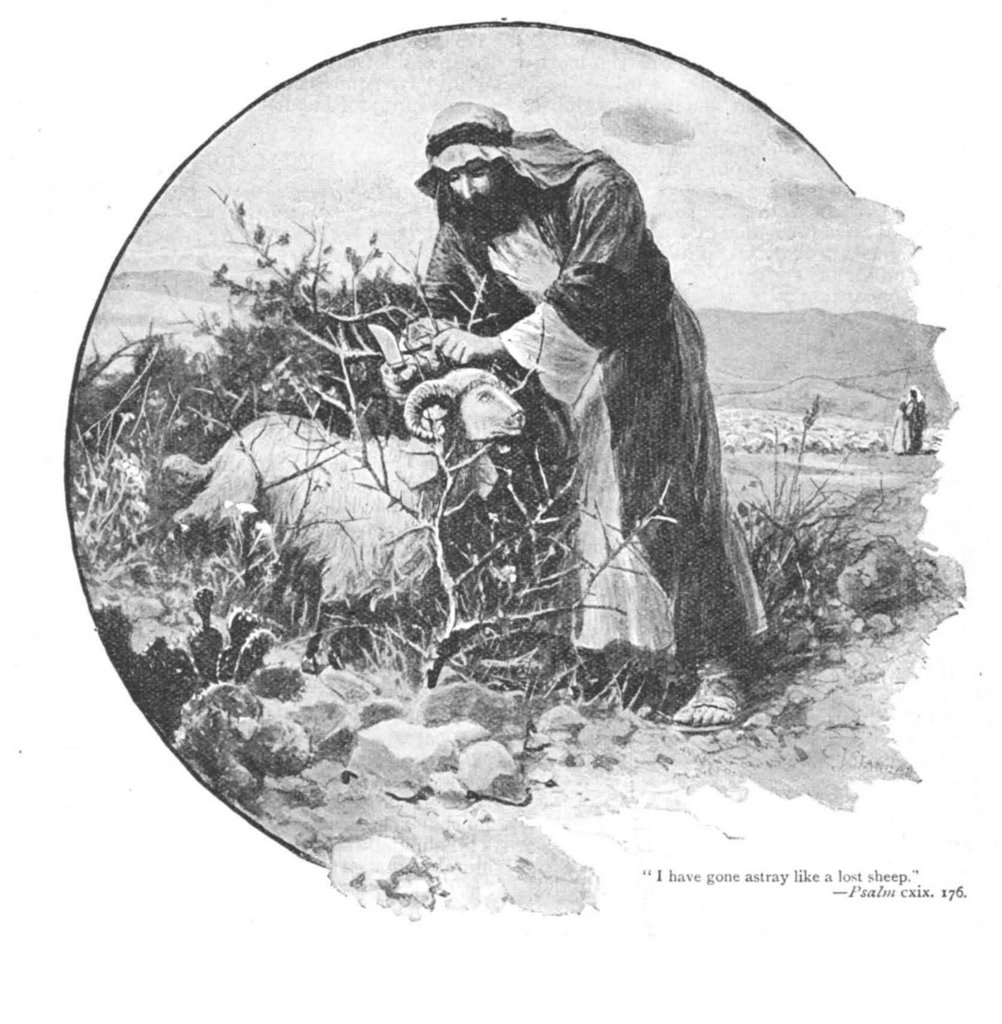
So you wish to stray and be lost?
How much better I do not also wish this.
Certainly, I dare say, I am unwelcome. But I listen to the Apostle who says: "Preach the word; insist upon it, welcome and unwelcome." Welcome to whom? Unwelcome to whom? By all means welcome to those who desire it; unwelcome to those who do not.
However unwelcome, I dare to say: "You wish to stray, you wish to be lost; but I do not want this," for the One whom I fear does not wish this. And should I wish it, consider his words of reproach: "The straying sheep you have not recalled; the lost sheep you have not sought."
Shall I fear you rather than him? Remember we must all present ourselves before the judgment seat of Christ.
I shall recall the straying; I shall seek the lost. Whether they wish it or not, I shall do it.”*


He was thinking hard, to the point of sweating, on his sermon for Holy Mass the next day. In the child-light, the cheerful brightness of the morning, the sheen of perspiration made him look pearly-white, yet earthy and not transcendent. But this belied the man’s spirit, for he was aflame with the love of his Master, rejoicing as each word fell on the paper, like so many drops of blood. It was if the sweat of his prayer of the spirit, the never-ending prayer enjoined upon him by the words of St. Paul, purified and cleansed him, and left him as both nourishment and purifier of the flock entrusted to him.

“You are the salt of the earth”, the light of the sun said as it caressed the face of the concentrating priest.


*St. Augustine, Sermo 46, 1-2: CCL 41, 529-530

Sunday, May 21, 2006

Tony


The picture is at ten percent. There he is, a figure among many, slivered in the crowd before Mass begins, and yet my eyes fall on him in particular. I suppose it is because he isn’t quite like the others. There isn’t the cake-beater business of the mothers in their unused heels, or the cowboy-nonchalant air of the single men, or the deer-in-the-headlights look of the single women: instead, this man shuffles, and looks down; his clothes are dark and non-descript, his feet like lead upon the dirt in the parking lot.

The picture is now at thirty percent. I notice now that he is shuffling and looking down because he has a little hand in his own. He is taking care of a little child; but intuitively, you can tell he is not the father, because he is taking such care with just this little one, as if this tiny blonde boy were the only child left in the world, the air of a 'special job'. I notice now, too, at this closer range, that he has a large growth above the right eye, like a dark brown cauliflower; this gives him a tree-like look, and I feel slightly repulsed. But the child looks at him with love and confidence.

The picture is now at sixty percent. He sees my little children, and slowly shuffles over with his small charge. “I’m Tony”, he says, “and this is William Thomas.” His clothes are warm in the warm day, and they are slightly dirty. Tony has a few teeth left, but he smiles a big smile nonetheless. There must be some second sight that children have, because my children respond gently and with security, like small flowers in the breeze. They don’t ask me about his mole or his teeth. He wants to show me the bay leaf tree, and smells it. I feel as comfortable with him as with the children; I am as warm inside as he must be in his warm fleece coat.

The picture is now at sixty-five percent. When Tony sees me the next time, a few weeks have gone by; but he lights up like an old friend. He is with the children again in the playground, and he tells me that he lives on the retreat grounds and is the nanny for the children. He smiles, not proudly, not in any way. Just smiles. He brings picture books for the children in church, who are suffering through each minute: after all, they have no sense of when all this sitting and standing and kneeling will end. They don’t know what a minute is, and Tony knows that.

The picture is now at sixty-eight percent. Tony wonders why we aren’t always there on Sunday, but he makes no judgment. He acts toward me and toward the children as he always does; the funny thing is, he does not seem to interact with certain people- it seems the more cowboy-nonchalant or beater-business, the less.

The picture is now at sixty-eight point five percent. I know that I know very little about Tony; for instance, why did he lose his teeth? But what I do think is that he is a Little One, there is a certain light around him, like white glow of the lamb in the green field, innocently standing out next to the large, off-white and black sheep, creatures full of their wool and their purpose. I do know that he has nothing, no power, no ambition to speak of, but of service. And I believe (I don’t know if I am right or wrong) that he brings something of Christ with him, without his knowledge of it. I do know that he seems to be at the top of the Right-Side Up Kingdom in this upside-down world.

I will never reach one-hundred percent, not ever. God only knows a person so well. It is like the problem of parallel lines in Euclid: the closer they get, the farther one is to calculating where they meet- and you are told that they never come together, else the whole structure of geometry must change. But perhaps, God's universe is truly Lobachevskian, in that the parallel lines do, finally, meet: in eternity. And there I hope to rejoice in Tony's glorious court.

Sunday, May 14, 2006

To My Shepherd


The following is a real letter written by a parishioner whose family roots in the local church run generations deep. He writes in response to an edict by the local bishop. Names and place names have been taken out-but unfortunately, this beautifully written letter could be apropos in many dioceses around the country.

Dear Bishop,

Our parish bulletin recently has published your order that we may no longer kneel at the “Ecce Agnus Dei…” or upon returning to the pew after receiving communion. It seems that another cherished and permissible custom of the people, of long and continuous practice, has been eliminated.

The publication of the notice included no mention of Cardinal Arinze’s Responsum of June 5, 2003. No supporting documentation, based on the authoritative teachings of the Church, as to why it is a better thing to eliminate the continuous custom of kneeling at these times has been provided. While we are ordered to give up our cherished customs, you and the priests of the Diocese reserve to yourselves the right to pick and choose which liturgical norms of the Church you will follow. Your picture on the front cover of the February Diocesan paper is ample evidence of this.

We must not kneel at our accustomed times, but other Diocesan parishes are permitted to celebrate Mass without kneeling at all. In at least one parish the precious Body and Blood is passed from person to person at Communion and in other parishes the words of consecration are tampered with. You know this, and you also know that nobody is publishing explicit directives to stop these practices.

In our own parish, the use of chalice veils and communion plates is banned. Priests refuse to genuflect at the consecration, others leave the sanctuary for the Kiss of Peace at every Mass, unapproved liturgical texts are continuously used, the people have been told not to make the sign of the cross at the end of the Penitential Rite, the Gloria can be chanted only once a month, and then only on the first Sunday of the month at 11:00 am. Extraordinary Ministers of the Eucharist appear at every Mass. The sacred vessels are rarely if ever purified by the celebrant. Except for an uprising of the people, the altar bells would have been eliminated some years ago.

The Sacrament of Confirmation has been a real trial for us. Through approving remarks and explicit directions, you and your Office of Divine Worship, in cooperation with Diocesan trained catechists have taught our children that they shouldn’t genuflect before the Real Presence, (bowing is the current fad), rock and roll and rap music, modified liturgical texts, and clapping and whistling are all appropriate to the Sacrament of Confirmation. You refuse to meet with concerned parents to discuss the matter. Even as many of you near the end of your active ministries, you, your Office of Divine Worship, and your priests, have the audacity to place yourselves between our children and their parents. You actively pursue the destruction of the last vestiges of the customs and spirituality that our families have handed from generation to generation for centuries.

Your generation is the generation that taught my generation. You taught us that with the advent of Vatican II, the dark veil of rigid authoritarianism, blind obedience, and silly guilt inducing rules had finally been lifted from the Church. We would all experience a great age of enlightened spirituality and unity based on freedom, diversity and respect for local customs. No more medieval European chains would bind us. No more fish on Friday!

And what of your legacy? You, your priests and administrators leave the scene disrespecting popular piety and family traditions. Diversity is a cover for disobedience. Tolerance does not extend to those of a traditional mind, who only ask some space in the Diocese, in the same way that space has been given to groups of various cultural and gender identities. You and your priests use your status in the Church to induce obedience to silly rules disconnected from tradition and reason. In the end, you leave us with the one thing that your generation claimed to hate most – blind obedience, supported by guilt. Except for blind obedience and the guilt associated with not following your directives, how else can we stand when our hearts and souls tell us to kneel?

In time, a new Bishop will come to our Diocese. If he comes to our parish, he may see everyone standing at the times you have mandated. But there are things he will not see - he will not see that some are standing because they don’t believe there is any Real Presence to kneel before, some are standing physically but kneeling in their hearts and souls, some stand so as not be ostracized as troublemakers, and others are standing for no particular reason other than the fact that everybody else is. The new Bishop will not see something else – he will not see the parishioners who are in the neighboring Diocese for an Indult Mass, or those who tragically have gone to independent chapels or who have simply given up and go no where at all.

The new Bishop will not be able to see these things, but he will see clearly that if the people were acting within the context of organic liturgical development, firmly grounded in the Tradition of the Church, you would not have had to issue edicts to force your personal vision of the liturgy on us in the first place.

Sincerely,

A Catholic

Monday, May 08, 2006

The Right of Love


Today, as I walked beside You, I heard You, teaching me to find You inside, in that place where I rest on You. And I saw it as a work, but a work of love. I thought of Mother Teresa, who always rested in You, by resting in Your Mother’s arms: she said the Rosary, nonstop, through luncheons, through plane flights, through the streets of Calcutta. I thought of Our Lady, and St. Joseph, in the heat and idolatry of the Egyptian cities, in Nazareth, in Jerusalem. Our Lady at Calvary, I thought of her, always resting with You, even in distress. And I thought about how much lower I am than that, than any of Your saints. How can I face the Cross like she did? How can I embrace it with Christ, like she did? I am not of that delicate, yet strong constitution: the constitution of the Virgin, with a heart always with You and in submission to You, a heart always trusting, never wavering, even in the viscitudes and waves of this life.

Then I heard it, inside-like: “Call on the Right of Love”. The Lord God Himself has said He loves us, loves us. And that love, love itself places incredible obligations on the Lover. It is to will the good for the other, to always be there: and in the ineffable greatness of God, to raise us up far beyond what we can imagine or even begin to do ourselves.

“You have the right to call on Me, to ask with all confidence for Me to make you a saint: to make your heart like Mine, to give you grace beyond measure, to do all, to raise you up to your Father’s embrace: this, daughter, this is the Right of Love.”

So, filled with joy, I called on Him in His Own Name: my only confidence is His Love, and the obligations of it that He has bound Himself to: to be a saint, to be so on His strength, for I have less than none (I am a fickle creature); to be made worthy by His worthiness. To be afraid only of what He wishes me to fear.

And He does all this while never truncating our free will. It is a balance so delicate that only God could conceive it.

My heart was bursting! All my life, I have heard things like I’ve just spoken of: He loves us, we can do nothing, etc: but I was fingering a dark wall, never feeling the edges of the door. Today, suddenly, the door was opened from the inside, and light flooded my dark soul. The Right of Love; an Eternal Lover who has bound Himself time and time again to His creatures by Love; it is there, everywhere, for all to see, repeated and shown in a myriad of ways. It seems to me that it requires only a desire, a small, even clumsy, movement of the will to set all aside in order to find Him. Then, in His time, you find that He has been all around you, all along, like an eternal embrace.

How I love Him: yet my love means nothing without Him: and He has given Himself to me, to all of us, and within the Right of Love, to make us His beloved, His saints. The door in the wall is Christ; and the Right to Love is the willingness, the cords of obligation that makes Him a door for us.

He is the Way, the Truth and the Life.

Thursday, April 27, 2006

Eight Years On


I've known you, really known you, for eight years now: for you never really know your husband until you've married him, until you've ironed the five thousandth shirt, or you know exactly which animal he looks like at any given moment (this morning it was a horse looking at you right before you put his saddle on, ears pinned back and pulling the eyes sideways). You only know him when you know that eventually, he'll figure out what really moves you.

I only think marriage begins, really, really, at the seventh or eighth year. Just when a lot of people really feel like getting out of it: the irony is that it is just really beginning to root in and grow. Perhaps if one wants to get out at that time, it means that you were never really in it for the right reasons. The great secret is that you can decide to now have the right reasons. Real love is that tough.

You were tough when I first met you, a modern knight on a creaky used bike at St. John's. You were so fun to watch, streaming like a flag past everybody on the football field, like the flagman in the calvary; and best yet, your flag had the cross on it, a real cross, a crucifix, not like the stupid sterile "resurrection cross".

Who cares if your zeal was part of a wounding? I saw you, as real love allows a true vision that others cannot see. God gave me that vision, which has carried me through. Who cares if you totally pissed off my whole Protestant family with very tactless Catholic proclamations? I knew it was done out of love, real love, and that they'd just never experienced that in our tactful world.

You were always honest with me. You came along, like a cold shower, like a fresh antiseptic on my wounds, and whipped me into shape.

How I have loved you, but I never felt so clearly until eight years on. Perhaps it takes that long, perhaps it takes 4,204,800 minutes of hoping and going up and down. My mother says it takes forty years, that the golden years are really about the marriage at that time of its day when the sunlight is slanted, making a beautiful, soft glow enter into every part of it.

I suppose then, you and I are still in the morning. But you've been my friend, my enemy(when I was bad), my cross (when I was good) and my fellow traveler towards heaven. Your weaknesses and wounds have been put up against my strengths, using them up to help you heal: and my weaknesses have challenged your strengths.

So marriage, eight years on, is like when you wake up after the first couple days of a strenuous hike, and your muscles are finally clueing in, and have given up screaming. It is when the sun hits you and you smile, and you know that without Our Lord, without the Blessed Sacrament, Our Lord present to us in the Eucharist, without Confession, without fellow Catholics and fellow lovers of Christ, without our families, our parents, our children, without all those gifts-the most important is Our Lord Himself- without Him, we wouldn't have made it home in the same plane from the honeymoon. You know that you are generally a jerk, and so is he, but that God has big plans for you both, and the happiest thing is to see us getting there.

You know that when you're sitting on the couch at night, and three little heads are bopping up and down, you know that in that cacophony of child-noises, you can catch an eye, a blue eye, full of new wisdom, the wisdom of a young and brave father, and you can share a silent laugh at our attempt to say the Rosary.

Blessed be God, in His angels, saints, and us.

Monday, April 17, 2006

The Spouse of Love is Truth


"The right path is not, and never will be, an easy one. And as I mentioned, it is so easy to be taken morally hostage by family members. But we cannot allow ourselves the contemporary canard of divorcing love from the moral law. Rather, we must follow Christ: "If you love me, do as I command." How can we help others if our love, and their lives, are separated from moral truth? The spiritual and pastoral art is communicating this to others (particularly hard as it is in the case of loved ones) in a gentle and yet effective manner."


"It isn't easy, Father. You know, now, I have a hole in my heart that moral truth does not fill."

"Daughter, Our Lord will fill it."

"How?"

"In His own way. Remember that He said, 'He who gives up home, family...for My sake will receive a hundredfold'."

"Yes, but like Job's new family, how does it make up for the lost ones? They are irreplacable."

"Daughter, what you have done is to show him the narrow path- whether he sees it now, or later- this is up to him. You know the Lord never takes our free will from us. You have done a small thing, small in the Lord's eyes, to show him that his way is not good. And your very suffering will be further evidence to him. He knows you say this, and do it, at great cost. And never forget that He loves him, much more than you ever could. Remember the lost sheep?"

"Oh yes. To see him upon the Lord's shoulders would be -"

"-wonderful. Take courage, Daughter. We live most of our lives in faith, in the dark-"

"-like the cloud of unknowing?"

"Yes, yes. We find the Lord in this life within the seeking. We find Him in obedience, even when we don't fully understand His commands, and even when, perhaps, it is very costly. I am thinking of him and of you when I say this."

"That is why, isn't it, Father, that we can only truly live righteous lives with joy when we have our heart set on knowing the Lord in heaven-as we are known. Otherwise, it becomes pharisaic judgement."

"Love changes everything- but as Edith Stein said, 'Accept nothing as love which denies truth, and accept nothing as truth which has not love.'"

"My heart is not so empty- or perhaps the wound makes sense."

"It is the sense of true sacrifice- only when offered in love, like Our Lord's crucifixion does sacrifice find its meaning."

"Still, Father, I am afraid. Afraid of him staying on the wrong way-"

"Perfect love casts out fear. It is a gift you must ask of the Lord. Like the courage you need, the sense of love tied to truth, the highest standard of love, that we are all called to, now in the face of loss: even those who we love the most. Leave him with God."

Saturday, April 08, 2006

The Fragrance of Fullness


It was a spring day today; sweet and gentle air seemed in control, vanquishing delightfully the normal smells of fertilizer and car fumes. The light was slightly slanted, and warm, so that each leaf on each tree was lit in the splendor of new green, and the Poor Clares Convent nestled in the little valley below the coastal hills like a hen settling into her covey for the evening.

We parked, and ten percolating little girls bubbled out of the cars, spilling merrily along the sidewalk toward the convent entrance. A bell rang, far off in the silence, and a little hunched-over nun opened the door. She looked an era old, but was resplendent in the habit of St. Clare. There was a busy-peacefulness about her, as she settled us in the visitor’s area in front of the grille, the lofty patchwork of wood that was the boundaryline between our world- a choppy, rushed, windswept and kalediscope place- and theirs- a mystery. I had never been to a convent. Being there is different than seeing it on a movie or reading about it, for there is a thousand immediacies which cannot be caught on film or page: the kitchy-seventies chairs from the little kitchen, a kitchen with only the essentials; as one little girl put it, the ‘nun-spiders’; the quiet, serious statues and paintings; and that grille, a strange conjunction between jail-visiting and a chosen desert.

The door in the room on the other side of that grille opened and Mother Trinitas of the Indwelling wheeled herself in. The ten girls all stood up, and she came to the grille and stood up, her small, old face peeking at them. She had a way of looking carefully and at close proximity, but not from infirmity, rather from interest. And she looked at each child in a slow and quiet rhythm, a rhythm it seems born from a different life. She would talk, in soft tones, and it seems no word was wasted; each sentence pregnant, each movement a harmony of silence. Yes, I remember her words. But I remember most her rhythm and the powerful exhortation she made to us: “Do not be afraid of silence. It envelopes you; in it is music, and you listen to God in that silence. When you are helping your mother, when you are at church, stop for a minute and let the silence take over: and listen.” That exhortation was a jewel set in a heavy gold ring, the ring that was her manner; a manner cultivated over many years of silence, purity and prayer.

Another Sister came in, and as they related to each other and to the little girls, our Little Flowers Club, I watched their eyes. There was happiness- to see us, yes, but a happiness that cannot be but an old happiness. Have you ever been to a flower show, to see some very rare and carefully raised breed of rose or peony? Or perhaps an Italian villa, built carefully over centuries by the same family, where every plant, every stone, every field and stone wall has been tended? You can recognize the fruit of many years when you see it. The happiness in their eyes, seemed to me to be the fruit of many years.

We drove away, and I didn’t want to talk about what was in my soul, so I made some jokes with the girls. The rest of the day, I was so happy, as if some grace from their crystalline fountain had been poured into me.

I wonder: can we cultivate something of that grace, that fullness -of -silence rhythm in our lives? Or is that the gift of the Bridegroom for His brides alone? It seems to me that it is a gift, that it is a certain loveliness reserved for the Brides of Christ. Yet this does not make me unhappy, rather it makes me see that like the peonies, we all have different fragrances; that at the end of St. Paul’s race, at the fullness of our life with Christ, whether we are, like Ven. Anne, eleven- or like Mother Trinitas, eighty: that at this fullness, we give glory to God in the way He assigned to us. The way He made us. Perhaps it will be the fragrance of suffering, perhaps the fragrance of the missionary, or my fellow mothers, the fragrance is coming from the reddened and workworn hands, hands and breasts and faces worn in childcare; a life sacrificed and not selfishly held. So perhaps we do not know what fragrance we give off as we reach our fullness. Perhaps the Poor Clare nuns we met do not know how sweetly their souls smell.

Pray for vocations.

Monday, March 27, 2006

Apostle of the Nursery


Just recently, I found myself 'introduced' to a new friend. Her name is Venerable Anne de Guigne, and she is the Apostle of the Nursery. As seems appropriate, I was reading a child's catechism book with my four-year-old daughter, and there she was, completely grabbing the heart of me with her expression, her inner beauty drawing me to her. My daughter and I sat staring at her image for a minute or two (that is a long time for a four-year-old). Well, perhaps it was more me. I decided I must find out more about this young girl.

That Sunday, I was in the bookstore after Mass, and there she was again, the same photograph, staring at me from the bookshelf. Again I felt grabbed. I remember now a good friend once told me, "You do not get 'interested in' a saint- he or she calls you"- out of grace, in God's plan, I believe. I have felt this "drawing" a few times and it seems like someone in heaven is flyfishing for me and finally caught me; there is a distinctive tug. Often, I believe, it is an answer from Our Lord to prayer: He often sends His saints to walk alongside us for a time, or for the rest of our lives. We do foster devotion, but this can I think quite naturally wax and wane, depending on our journey of salvation.

So Little Anne caught me. I bought the biography and read it that night. I found myself at 12 am weeping and weeping, at the beauty of this child, who, "climbed the mountain of sanctity by going up a cliff face... God called her to come quickly and she came quickly.."

She was converted at four years old, the catalyst being the death of her father in the Great War: it is thought by those who knew her, that her father's sacrifice for his country and his family, his faith at the threshold of eternity, that these gained great graces that the father left his daughter as an inheritance. "The graces poured through this open wound...her soul was cleaved and she was no longer the bossy and willful child.."

She truly was the Apostle of the Nursery, in that her greatest efforts, somewhat like St. Therese of Liseux, were in little things- but done with heroic efforts to put to death the willful and sinful parts of her. She took the admonition, "Obedience is the Sanctity of Children" quite literally, as a child would do, quite literally in every little way. But her struggle is evident, all the way to the end. A reading of the biography by "A Benedictine Nun of Stanbrook" is the only way to really understand Anne.

I wept after closing the book upon the last page, after her death at eleven years of age, a death she was called to by love, and realized she was coming into my life as an answer to prayer for my three children, for whom I have been afraid in the culture we live. The end, that is, heaven, is all that matters: to know that your child is working hard towards God and not away from Him. To know that you are doing whatever He calls you to do in your great responsibility, this is peace within the vocation of parenting. And I know I cannot do it alone, we cannot do it alone, my husband and I. These days are too shrouded with the smoke of Satan. So Anne came, and I am so grateful. May she become better known, the Apostle of the Nursery and of Big Sinners.


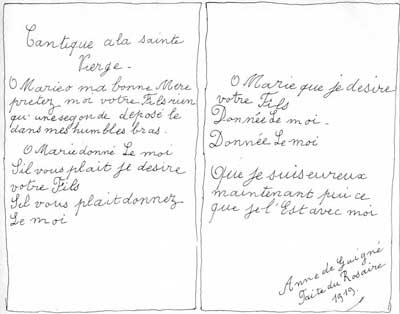
Translated:
O Maria, my good mother,
Give to me your Son and
lay Him in my humble arms

O Maria, give Him to me
If you please, I desire
your Son
If you please, give Him to me

O Maria, it is that I desire
your Son
Give Him to me
Give Him to me

I am happy now
that He is with me.

Sunday, March 19, 2006

Stabat Mater


This Lent, as usual, I decided to fast and give up sweets. True to my randomness, I didn’t give myself good specifications on what and when to fast…after a mildly hard week of unexpected sickness and tiredness, I lost my mind- well, not really- I just lost my willingness, and downed a couple cookies in a secluded parkinglot. I felt so lame, so weak, later (after the sugar high died down).

I’m not one to write authoritatively on suffering, for I am so bad at it. I tend to go numb, a kind of shock, wherein I can appear to function smoothly and calmly, much to the mistaken admiration of others. Then, later, in the recesses of the heart, the anger comes; and it is an old anger, born in the time when I was reaching the age of reason- and nothing seemed reasonable to me. It is the anger that frightens me now, because I do not wish it to turn into resentment and bitterness, as it was before I turned back to Our Lord from years of anger.

Anger dipped in pride becomes bitterness.

So it is that I am afraid of suffering, because I can’t deal with it, I can’t respond with love, with offering as I see the saints have done. I have never really resonated with St. Therese of Liseux as she wished for all the martyrdoms in the world. As I understand more about loving God, and His loving us, as I understand the traditional faith, I understand with my reason why St. Therese would say this: but I do not understand with my whole being. Can I honestly say I wish to?

I was driving today, and these are the quietest times I have, real moments of solitude with Our Lord- anyone who has small children will know what I mean. I began to understand something- that we cannot suffer as a saint, we cannot be perfect as the Lord is perfect, ourselves. We will all suffer. There is no family that does not have immense tragedy and suffering- hidden, or not- but can we endure it and turn it to love instead of anger at God, instead of hurt pride and bitterness? For turning suffering to love is what a saint does, in imitation of Our Lord.

It is the Sorrow of Mary; to watch Beauty killed, to watch Love hated, and to feel it as only a mother can; and yet to turn and love, to receive again the Holy Spirit at Pentecost, and send her Son’s apostles out to be killed also; it is her hope, hope vivified by faith and prayer, hope in suffering turned into love for sinners and saints alike.

I saw, in those quiet moments in the car, that the only way we can turn our suffering into love is to live within the Hand of God; I picture myself in His palm, taking the love and warmth, the grace from Him, along with the suffering. And as I was thinking of those in my life whom I want salvation and peace for, those for whom I would suffer, the realization came to me that offering the Lord our suffering for those we love is a prayer with real meaning, these the Lord takes gently and lovingly.

The ability to turn suffering into love is correlated directly with being in love with God. And all of it is a gift- any ability we have is a gift. Suffering purifies. Yeah, yeah suffering purifies, we hear it all the time; and sort of tilt the head to the side and give a little nod. Suffering doesn’t have to purify, though; it can embitter, without our willingness to turn in love to God and ask Him for the good out of it.

To give up things or people we want, to accept calumny, or poverty, or injustice, or illness, or failure; to bear with handicaps and disorder within ourselves, and most especially to give up these things for the sake of Christ, for the laws and desires of God: these can come to us and take off our thick skins, our scales on our eyes, our stone coverings for the heart. Like a crab molting, we become soft little creatures that can feel and understand others’ suffering in a real way; and we become more aware of God, more able to contemplate Him. But that little, vulnerable crab cannot long survive outside the hand of God.

A person who is suffering and contemplates a crucifix has a lightingbolt connection to the Suffering God on the cross. A person who suffers and deeply loves God hates sin the way it should be hated- and most of all when they find it in themselves. A person who suffers and yet loves, even the very person who causes them the suffering, loves more like Christ.

The figure on the cross, so vulnerable, so willing. The enormity of the crime and the enormity of Love live side by side. It is a mirror of the world as we know it. Only the Lord can make us be those who will turn suffering not into bitterness, but love. We must, however, be willing- and more than that: we must be willing to search after Him like the Beloved in the Song of Songs, each one in his own way, because the Lord loves us each, as if we were the only creature He had made. Be in love with God, because then you can resonate with the saints, everything then becomes Love. May it be so for me.

Wednesday, March 15, 2006

A Traditionalist Gone Mad


It is requisite for the relaxation of the mind that we make use, from time to time, of playful deeds and jokes.
- Saint Thomas Aquinas

Humor is the only test of gravity, and gravity of humor; for a subject which will not bear raillery is suspicious, and a jest which will not bear serious examination is false wit.
- Aristotle

A person is said to have a sense of humor if he can "see through" things; one lacks a sense of humor if he cannot "see through" things. No one has ever laughed at a pun who did not see in the one word a twofold meaning.

Archbishop Sheen

Note: The following IS fictional. Don’t get any ideas about the person in the picture, except that he has a great sense of humor in allowing this humiliating photograph to be posted.

A Traditionalist Gone Mad

You know, there’s something wrong here. Can a person be TOO traditional? What does that mean, anyway? How can you stand being TOO something that very few people have really even heard of? Or perhaps it is the danger in being in a marginalized setting, this TOO-ness. Like you get too close to the wacko magnet or something.

Look at that picture. He’s looking at something on the computer and it finally snapped him. Perhaps it was yet another photo from a church in some Scandinavian city, where the loose ends are getting really svelte and tight. I mean, those Germanic types know how to make blasphemy really – efficiently stylish; like the BMW of bad liturgy. You know, compare that to the loose-joint, cheapy plastic Tonka-toy liturgies of many American churches nowadays, bent on bringing the Protestant Mainline Sunday school classes into the church and letting them ‘design the liturgy’.

At any rate, even though my traditionalist-gone-off-the-deep-end-friend may be seeing things as they are, he seems to have lost it a bit. He is starting to feel like there must be a remnant of The Remnant; when I tell him “There’s an empty seat” he thinks I am talking about the dubitable status of the last five (or ten) Popes. He doesn’t see the strange irony in that there is a Pius X Society and then, somewhere in the shadows, there is a Pius V Society. Was that done on purpose? He can’t have a good laugh anymore, or revel in that Hillare Belloc sensuum Catholicus: “ Wherever the Catholic sun doth shine, there’s always laughter and good red wine; at least I’ve always found it so, Benedicamus Domino”.

Well, actually, where does the Catholic sun doth shine? Malta? On certain bishops like little spotlights in the darkness? It certainly isn’t shining in beaurocratic offices with nameplates like: “Office of Extraordinary Ministers”. I’d like to take a permanent marker and change it: “Office of Ordinarily Extra Ministers”. It doesn’t shine on those architectural munsterpieces, churches that look like frozen tee-pees. It certainly doesn’t shine on stained glass windows that look like they were blown out of their frames and then put back together by the preschool catechism class. But it doesn’t shine either on those humorless, purse-lipped ninnies who haunt the coffee hours of the traditional masses and complain about how the congregation really shouldn’t make any sounds whatsoever, ever(even if the rubrics call for a little, quiet chant reply here and there). It doesn’t shine on neo-traddy-pharisees, and I’m afraid my friend here is heading that way. How to stop him? Take him to Malta?

I need to take him where the Catholic sun doth shine. A sun of love, and life, and hearty tradition, a place of families who can afford to be large and have the extended family to do it in peace and security. A place where the steeple rises in the middle of town, and one can hear the Angelus bells ring out and echo on the hills. A place where the priest is the Altar Christus, and the incense symbolizes prayer, and the focus is on the Lord, on His Body and Blood- and everyone knows it. A place where no one knows what the word “liturgy” means; instead, they only know the Mass as it has been for two thousand years. A place where table wine is part of lunch on a warm square, where neighbors chat and remind each other good-naturedly not to gossip. A place without the bitterness of betrayal, the bitterness of atheistic, secular, modern life. A place where women want to look like women, not prostitutes. A place where men laugh together. A place where the Lord walks freely among His own.

I guess I am hoping for heaven. But, like the Marshwiggle said in CS Lewis’ Narnia, “I will search for that sun, that Narnia, on in the dark- for it licks your "real" world hollow.” Hope is fed on faith in God’s providence, and prayer, and love: and humor.

Monday, March 06, 2006

Burning the Frankincense


I know I’m a little out of step with the liturgical calendar, but I finally finished this painting, in oil, titled “Burning the Frankincense”.

I imagined Our Lady holding the frankincense, just after it was given into her hands by the Wise Men, and pondering this gift in her heart. My thought, during this meditation, was that she would have wanted to burn it, in worship and homage to her tiny son; yet it was, somehow, a very private matter and a great priviledge of hers and of St. Joseph to burn the frankincense.

Why frankincense? The myrrh was safely kept, kept for the day of death, for the time when Our Lady would use it in anointing Him, the invisible scent of a Pieta. The gold? I do not know, perhaps it was a timely gift for use in escape and for life in Egypt. But the frankincense, when should this be used?

Frankincense, like myrrh, is made from the sap of a desert tree. It was so rare and expensive, that it was used almost exclusively for the shrines and temples of the ancient world, and incorporated into the rituals surrounding the Holy of Holies. Thus it was a powerful sign, through the hands of the Kings, that here was not a mortal King only, but here was Divinity.

In my imagination, the Kings give Our Lady the frankincense encased in a jade censer, or burner, along with some charcoal tablets, pressed and made for the purpose of burning the frankincense granules, or pebbles, easily. Our Lady and St. Joseph would probably not have been expert censer-starters, so perhaps they would have been shy for this reason as well, from doing this in the evening when anyone might have been around.

I picture them staring intently at the incense just starting to burn, as St. Joseph holds his cloak over as a ‘tent’ to catch the fragrant smoke. He also hides the scene, much as he was called to do as Our Lord’s human protector during the hidden years of childhood. This spark, this tiny, incandescent moment of lighted worship, both in the physical and metaphysical sense; this instant when, if one were looking with eyes of faith and love, one was allowed to see God laying in a crib, encircled by His Mother and Foster Father- holds greater beauty than all the evil and darkness of the world.

Saturday, February 25, 2006

The Destruction of the Al-Askari Shrine in Samarra


A shrine in Iraq was reduced to rubble, its distinctive golden dome now a sulphurous shell.

Aside from the importance on the suffering this has caused afresh in Iraq to the people there, there is a rather strange and, I believe, important story attached to this bombing. It is a story that reaches across history, prophecies in two faiths, and geography: from Iraq to Portugal to Israel, from Rome to the plain of Armageddon.

We will start with the birth of a little girl in Anno Domini 606 or 614, depending on the tradition you consult. She was to become the favorite of Mohammed, whom the Muslims name “Prophet”. Perhaps she was pretty, but it seems on all accounts that she was very virtuous and sensitive, a lady whose tears over her husbands’ taking of another wife are venerated, whose silver, symbolic burned and suffering hand is worn reverently around the necks of millions of Muslims. Her suffering and patient forbearance are celebrated; her sadness and depression at the end of her life, due to the evils she saw around her seem to resonate with us Catholics: she is called ‘second to Mary, Mother of Jesus’ in Muslim tradition. Her name was Fatima.

Fatima’s sons were the catalyst for the eventual split between Sunni and Shi’ite Muslims; for the children of Fatima are considered by the Shi’ite Muslims as the true successors to Mohammed, the Kaliphs. The ensuing history of Fatima’s progeny bear out the legacy she left of suffering and tears. Her husband and sons, down to the 12th Iman, were fighting and losing their battle to retain their heritage as Kaliphs, or successors to Mohammed. I refer here to some better-explained history:

The line of Mohammed through Ali and Hussein became extinct in 873CE when the last Shia Imam, Al-Askari, who had no brothers disappeared within days of inheriting the title at the age of four. The Shias refused, however, to accept that he had died, preferring to believe that he was merely "hidden" and would return. When after several centuries this failed to happen, spiritual power passed to the ulema, a council of twelve scholars who elected a supreme Imam. The best known modern example of the Shia supreme Imam is the late Ayyatollah Khomeni, whose portrait hangs in many Shia homes. The Shia Imam has come to be imbued with Pope-like infallibility and the Shia religious hierarchy is not dissimilar in structure and religious power to that of the Catholic Church within Christianity. Sunni Islam, in contrast, more closely resembles the myriad independent churches of American Protestantism. Sunnis do not have a formal clergy, just scholars and jurists, who may offer non-binding opinions. Shias believe that their supreme Imam is a fully spiritual guide, inheriting some of Muhammad's inspiration ("light") . Their imams are believed to be inerrant interpreters of law and tradition. Shia theology is distinguished by its glorification of Ali. In Shia Islam there is a strong theme of martyrdom and suffering, focusing on deaths of Ali and, particularly, Hussein plus other important figures in the Shia succession. Shi`ism attracted other dissenting groups, especially representatives of older non-Arab (Mawali) civilizations (Persian, Indian, etc.) that felt they had not been treated fairly by the Arab Muslims.

Sunnis and Shias agree on the core fundamentals of Islam - the Five Pillars - and recognize each other as Muslims…. However, there remain significant differences between the two forms of Islam and these are what tend to be emphasized. Many Sunnis would contend that Shias seem to take the fundamentals of Islam very much for granted, shunting them into the background and dwelling on the martyrdoms of Ali and Hussein. (From “The Origins of the Sunni/Shia split in Islam” by Hussein Abdulwaheed Amin, Editor of IslamForToday.com)

Fatima’s legacy is like a live wire in Muslim history. Her last son, or descendant, was the 12th Iman, Al-Mahdi. He was a four-year-old when his father died and he was taken secretly to a cave, to be hidden from those who wanted to take his life and end the succession. He disappeared only a few metres from the place where his father and grandfather were buried. The Shi’ites wait for him to return. The place of the sirdab(cave) of disappearance and the burial of the last of Fatima’s children is the Al-Askari shrine in Samarra, which was destroyed a few days ago.


The level of anger of the Shi’ites is commensurate to what they have lost: the dignity of the shrine of the 12th Imam, who is for them, the savior to come, who will lead the Muslims to victory against the Christians and the Jews. There are many prophecies associated with this 12th Imam and his return; that in between the two times that the Jews master the world”, a great leader:

The term "MAHDI" is a title meaning "The Guided one". Mahdi is a normal man who is going to follow the true Islam. His name will be Muhammad and his father name will be 'Abdullah. He is a descendant from Ali and Fatima (daughter of the prophet Muhammad) so he will be descendant from al-Hasan or al-Husain. Mahdi will be very just and his capital will be Damascus. Allah told us that Jews will master the world two times (we live now 1998 during the first one) and Mahdi will appear between those two periods and will rule through the last one. Mahdi is NOT a prophet but he is the final Rightly Guided Khalifa. Mahdi will lead Muslims to a great victory against the Christian Romans (i.e. All the white Europeans including the Americans). This great war is called al-Malhamah al-Kubrah or Armageddon. It will end up with a great victory to Muslims against Romans after six years. Muslims will take over their capital Rome (this can be any city). In the seventh year, the Antichrist will appear and a greater war will start between Jews and Muslims for 40 days (longer that usual days) and will end when Jesus (pbuh) will come and Muslims will kill all Jews. All people will convert into Islam. Peace will pervade the whole world. (From “Who is Imam Al-Mahdi?” onwww.islamicweb.com/history/mahdi.htm).

Thus the Shi’ites, arguably the more apocalyptic of the Muslims, are reeling in shock and anger at the destruction of what is probably their most holy site, next to the holy sites of Mecca and Medina. The references to Armaggedon are interesting; for Armageddon is actually a plain outside of Jerusalem, which is named as the site of the last battle, the battle fought before the Prince of this world is destroyed en fin.

What surprised me to find in my research is the apocalyptic references to a Muslim occupation of Rome- meaning, symbolically, the Muslim victory over the Catholic Church, specifically; yet Jesus is spoken of as returning and establishing peace. It seems incongruous, yet this makes sense, because as the great historian Hillaire Belloc stated, Islam is really a Catho-Judaic heresy, an ‘unbalancing’; therefore, mixed theology and irrational mixtures are to be expected.

From the Muslim perspective, namely the Shi’ite, the Last Days are to be ushered in with the re-appearance of the 12th Iman and the victory granted to Muslims all over the world. If one has been following the news at all, it will become obvious that the Muslim world is in turmoil from many causes: war in Iraq, terrorism, a clash with Western secular culture (think ‘cartoon’), the proposed strangulation of democratically elected Hamas in Palestine, and strife mounting between the two strains of Islam.

From the perspective of the Faith, we may be witnessing the labor pains increasing, to speak apocalyptically. At the least, we must increase our prayers and sacrifices for the conversion of the Muslim- which Hillaire Belloc states is practically and humanly impossible. It must be a work of the Lord, in His mercy.

We travel now from Jerusalem and Armageddon, from Rome, to a small village in Portugal, which I believe, holds the hope for the Muslim and the Catholic alike. We go to a village named Fatima: legend states that the village was named for a young Muslim girl who converted to Catholicism; she, in turn, must have been named for the Lady Fatima, Mohammed’s daughter.

Here, in this little farm village called Fatima, Our Lady, the Mother of God, appeared. She was sad, saddened by sin and evil, as it was recorded that Mohammed’s daughter was. But Mary, unlike Fatima, is our Mother, and called the most blessed of women- by the Muslim as well as the Catholic. She called for repentance, for suffering to appease God and to convert sinners. All of us are sinners, but I place emphasis on the word ‘convert’ because that seems to call to those outside of the Faith.

Eight years ago, when I was converting to the Faith established by Our Lord, I was standing in the vestibule of St. Mary’s Church in Annapolis, Maryland. There was a woman there with me, head covered in the Muslim way; and she was crying. I asked her why: she said she was Muslim but wanted to convert to the Faith. Surprised, I asked her what had brought her here to this church, so out of the blue. She replied, “It was Our Lady Mary- she brought me here.” I smiled, and told her that I, too, was coming into the Faith. So Protestant and Muslim met in the vestibule of St. Mary’s. I often think of her, and wonder: was she one of the small, first drops of rain- the first of millions of Muslims to come into the Faith?

Archbishop Sheen was a prophetic voice: anyone who has listened to his tapes, especially on abortion, will recognize this gift in him. He spoke once, about Fatima. With passion, he shone light on the fact that Our Lady came to Fatima, a name so symbolic to Muslims, most especially the Shi’ite (who are most probably the most anti-Western, and conflate Western culture with Catholicism). He believed that Our Lady of Fatima would be instrumental, perhaps essential, in the conversion of the Muslim.

This scenario reminds me of the situation in Mexico when Our Lady of Guadalupe appeared. She came to the hill of Tepayac, the hill reserved for the “Snake-Goddess”- here we have a similar pattern to Fatima, in that Our Lady came to a place that the Indians would recognize as significant, a feminine presence, and yet Our Lady, with the power of her Son, converted them; by the millions in a space of a few years. Also interesting is that “Guadalupe” is an Islamic word, from a river so named in Spain during the time of the Moors.

So in these days of turmoil, let us gird ourselves in the Faith, keep our lamps lit and pray- especially now for the conversion of the Muslims. With God, nothing is impossible.


Sunday, February 19, 2006

Ring of Flowers, Ring of Thorns: A Reprint


The white ring of flowers is placed over her new black veil, and there is the heavily warm silence of rejoicing; a moment of true quiet, like the oddly hot and silky Santa Ana winds in a Santa Barbara night.

She then appears in the hall under the church, resplendent in her grey and black habit, her face joyful but shy, but her expression a bit flat- as though all the clapping and attention were too much for her. The slightly far away look is of one who is used to the safety of the habit and the convent, a translucent pansy, a greenhouse creature, a woman of prayer, a Spouse of Christ.

The rest of us, with heart-skins roughened by jobs, parenting and trying to be good spouses, have witnessed her marriage to Christ. A friend turns to me and muses, “Wouldn’t it be nice to be married to Christ?” I smile, thinking it a nice observation, considering the event. She goes on. “No, really. Really. To be able to have a spouse that you could really give your whole being- no reservations, no doubts, no anger at another imperfect human being.” Was it jealousy of another’s choice? “ No, not jealousy. I mean, I know we are all meant to be all for God, but I just think it would be easier to go to Him as a spouse, instead of always feeling torn-torn, between your duties and feelings about your own spouse, and your desire to give yourself to God entirely. It’s confusing, to say the least.”

Out of all the images, sounds and ideas of that day, that Profession of Vows, it was the strange dichotomy between the ring of white flowers on a new black veil, and the scratched gold ring on the worn hand of that woman which stayed with me. The question kept coming back to me, “How do you get to Christ as a spouse while married?”

In John Paul II’s play, The Jeweler’s Shop, there is a very powerful moment: a woman is wandering the streets at night, dazed and in emotional pain. Her marriage is a wrecked house, her faith its cracked foundation. She has decided to complete the ruination by finding a lover in the worst way possible: like a prostitute. A car pulls up. She looks at the man, his face disfigured by the rivulets of rain falling down the window. She reaches out for the door handle, and he opens the door. Jarringly she realizes that, although he looked totally foreign before, he suddenly has the face of her estranged husband. She backs away and stumbles down the street. Her clumsy flight is stopped by a priest sees her and who providentially, knows her from years past, when she was a young bride. My memory of the play is that she confesses her intentions and the vision of her husband’s face, in the place of a man she was hoping would somehow 'save' her from her misery; she tells him of her feeling that God has abandoned her. The priest replies, “Daughter, the face of the Lord will, in this life, have the face of your husband- and none other.”

It is a profound statement, at many levels, and more profound than I can hope to illuminate. The depth is such that it must be lived in order to understand it. The vitriolic reaction would be one, most likely of dismay; a disillusionment of romantic visions about Our Lord. And perhaps this is exactly what is good. The Lord was “A man of Sorrows, afflicted, not of comely feature.. Most of us may not have recognized the Lord in His earthly life, because He chose to be so ordinary- as familiar as the face of the spouse. The Jews, especially the ones more deeply steeped in the laws and religious practices at the time, missed Him, because He was the “son of a carpenter”. He must have been tanned, shouldering rather simple clothes, fitting in with the semi-poor of the time. It must have been impossible to recognize the Word, except perhaps if you observed Him more closely, and listened more closely. Perhaps if you watched the children with Him, or looked deeply into His eyes and saw the stars, or, as songwriter Bruce Cockburn says, “saw the way the dust swirled around His feet.”

It is this way with love. In his seminal work, I and Thou, the Jewish phenomenologist Martin Buber describes from many viewpoints the phenomena of two persons, two Others in a face to face relationship. It is the deepest relationship but in human terms, fraught with the most danger of becoming too narrow, into becoming narcissistic or other-worship. The great Catholic philosopher, Dietrich Von Hildebrand, in his book Man and Woman, baptizes Buber’s insights on the I and Thou relationship as only a great Catholic philosopher can achieve. It is not the “we”, the “side by side” relationship of friendship, wherein we look out at something together and share it. The I and Thou relationship is essentially different from this. It is a “face to face” relationship. Two persons are engaged with eachother, a holy relationship to the exclusion of the outside world. It is such a profound relationship because it , as Buber elucidates, produces fecundity- in other more pedestrian terms, this relationship is the catalyst for fertility, physical fertility in the begetting of children, and as Hildebrand develops, spiritual fertility: begetting love and true sight; begetting grace and changing each other into a unity, a new creature. So we would have had to look at the Lord this way in His earthly life, in order to recognize Him, and we must look at Him this way now, in the humble appearance of the Eucharist. Our souls, whether we are male or female humans, are female in the I and Thou relationship with God.

Our grand and glorious destiny is to become a new creature in Christ, in this I and Thou relationship. The story of Israel in the Old Testament is a forerunning image of this relationship God wants with each of us personally. One only has to read the passages in the Old Testament wherein God seeks after the straying Israel as a husband seeking his wife. By far the most distilled essence of this I and Thou relationship of God to Israel, God to Our Blessed Mother, and God to each one of us, is contained in the Canticle of Canticles. The I and Thou relationship is a running theme throughout God’s relationship to man, from the Old Testament to the Apocalypse.

Marriage is simply the incarnational, natural counterpart to this God-to-man relationship. It is one of the down-to-earth, natural ways which Our Lord uses to develop the understanding of the relationship He wishes to have with each of us. In a marriage, the I and Thou relationship still retains its ability to produce fecundity on both the physical and metaphysical levels. We beget children, and we become one flesh with another, we can fecundate the spouse’s spiritual growth. Dietrich Von Hildebrand says that rather than love being blind, it rather sees more clearly who the other is, sees things that no one else can see. In other words, in the I and Thou relationship, we see the truth about the other; and it is beautiful, tragic, glorious and frustrating all at the same time. Only in the I and Thou relationship with God are we compelled to fall to our knees in utter adoration at what and Who we see; with another human being, we are compelled mostly to nurture and to pity: and ultimately, by sowing unselfish, sacrificial love, to help in the salvation of the spouse. In phenomenological terms, as married persons, we are to cultivate the I-Thou relationship with the spouse in order to learn how to love God, and to help the other by forgiving, affirming and healing. Then, the marriage should develop again, back into a “We” relationship: but now the “We” is looking together at God, encouraging in the spouse the I-Thou relationship with Christ. In short, we are to aid the spouse to become a Spouse of Christ, by being the incarnational healing and love for that person.

The purpose of human marriage is multiple. We are angel-beasts, we have instincts and were told to be fruitful. The Church has always taught that the primary purpose of marriage is to co-create with Him new life. This is profound enough all by itself, but there are other purposes: companionship, an economic partnership, the making of a home, and a domestic church. What about the spiritual aspect of marriage? This is something that has been somewhat neglected, except perhaps by John Paul II; indeed, his writings on human marriage and the body are perhaps his greatest legacy to us. Somehow, mysteriously, the I and Thou relationship in a human marriage is the doorway for most people into that archetypical I and Thou relationship with God for which every person is created, the Beatific Vision. How is this? Here, I am venturing into my own musings: In a marriage, we see the truth of another person, and in their eyes, we see the truth about ourselves. In many, if not most cases, this is a painful progession from illusions to reality. What we do when we reach the reality, in all its failures and ugliness, is what we do with Our Lord on His cross, and the crosses in our hum drum daily life. When we reach the bottom of another’s personhood, when we see the truth, the beauty and potential alongside the selfishness and boorishness, we must make a choice. Many marriages end here, and the progression is away from an I and Thou relationship to a narcissistic existence, or to an abyss, which must be filled at all costs; or to repentance amidst the ruins. This journey into the depths of another is parallel to the journey of God with Israel. They saw Him first from afar, a cloud of fire. Then they heard His voice, and they knew He fought for them and punished them. Their knowledge of Him was from afar, but He was looking at them in particular. And they began, in their prophets, to look at Him. They made vows to forsake all others for Him, and He dwelt with them in the Holy of Holies. And then He came as a Man and He came as a humble Man, and He loved, and He became as a malefactor for love, He became the lamb of slaughter, He was lifted up like the snake in the desert, and they knew him not.

In a marriage, what happens when we look at the other, and we realize that we know him not? It is because love, in all its forms, eros, agape, storge, but mostly caritas, leads us to this place and then gives us a choice to go on, or to turn away. Our eros and agape and storge are all burned in this purgatory of the I and Thou relationship, and we are left with caritas. It is caritas which takes us beyond the bottom, and then we begin to discover the baptized forms of eros, storge and agape. And then, then, will we be ready to venture past the I and Thou relationship with a human spouse, and together with that spouse, become a “We” relationship again: but on a profound level, whereby we see God together. Our hearts will have been burned in the fire of a marriage, and then the gold of choosing to love in the face of suffering and disillusionment will shine out to God. C.S. Lewis wrote a book which he said was his personal favorite. It is called Till We Have Faces, and is the story of a soul’s journey from spiritual blindness to being able to see the truth about herself and the one she loved, and then finally to seeing God. The climactic line in the book, I think, sums up the spiritual purpose of marriage: “ How are we to meet God face to face until we have faces?” The I and Thou relationship of marriage is meant to give us faces, give us the truth about ourselves, to rip away all the roles and facades we are taught to assume- and then the relationship asks us to love from within that place of truth. Only from there can we truly see God.

Note: This article is an excerpt from a book on which I am currently at work (TRWK)

Thursday, February 09, 2006

A Grain of Wheat Falling


Shadow is often used to portray death- for death is always obscure to us, and dark, and we also keep it obscure in this modern world, even when it breaks down our doors. Like the shadows that seem to prey on us from the far end of the room at midnight, death waits in the recesses of our minds, minds cluttered during the day by deeds and words: but it waits.

St. Alphonsus Liguori exhorts us all, in Preparation for Death, to look carefully at that shadow, to bring it to the light, to examine it and to think about it: daily. Morbid? Depressing? Impossible? Perhaps, alone. For that seems to be the hardest thing about death: we travel through that darkness alone- no friends and family, no wealth or even the recommendations and testimonies of those we count on- we go alone, clothed only in what love we have seeded and watered. Even so, even in fear and trembling, St. Alphonsus asks us to deal with our own death. Why?

It is the same reason that “the best examination of conscience is to look at a Crucifix”. Death is a result of sin, the sin we all share as mankind, as well as our own sins. Only Our Lord came to take the punishment of eternal damnation from us who have accepted Him as Savior; yet we still pay the penalty of physical death, we still face our particular judgment. It is far better that we begin to face that judgment now, daily, to ask God to know ourselves and thus change with His grace and help, before it is too late. I am thinking especially of the words of Our Lord: “Do not let a man who has something against you take you to the court: negotiate with him on the way, so that you are not thrown into prison.”

Daily facing death is intimately connected with dying to oneself, if our dealing with death is not morbid or self-pitying, self –centered. For in this facing of death, we see ourselves more honestly. When we picture ourselves before the King of the Universe, a King-Judge, what do we see? We must ask for the grace to see ourselves as God sees us and for the grace to not remain standing, but to fall on our knees and clamor with joy because Our Lord is willing to save us- save me! Let this preparation for death make us honest, humble, and only too willing to “decrease so that He may increase”: to accept and rejoice in suffering because, as St. Gianna Molla told her husband after she had been revived (before her final death a few days later): “We are not fit to appear before the Lord without suffering.”

But how? How do we deal with death each day, in a holy manner, with peace and joy? St. Gianna was not speaking out of servile fear, but rather inspired and holy love of God. She understood clearly that we must undergo suffering for love, and to die to ourselves so that we may live for God unselfishly. I do not think the selfish see God- they are not able, they have not been willing or accepted the grace to be able to see beyond themselves. And I say this with trembling, for I am a cesspool of self-pity and selfishness.

So how? How do we accomplish this- this walking in the shadow, this dying to self?

Let us look to Our Lord, for He is our primary example. His life is an instruction in a holy abasement, a holy death. I construct my thoughts here from Fr. Doze’s book: In His twelfth year, Our Lord went to the Temple in Jerusalem. The mighty Temple! The golden House of God, filled with prayers symbolized and actualized with sacrifice and incense. His House! Here, here was His Father’s business; and He stayed, and stayed, teaching and loving His priests and the people coming to obey His commands- commands of liturgy, of religion. He knew their hearts. But still He stayed.

His mother comes, she comes on the third day, a day forever appointed as a day of metamorphosis. She comes, with St. Joseph the Shadow, and she says: “My Son, why have you done this to us? Your father(my emphasis) and I have been looking for you for three days.”

Our Lady uses the term for father, earthly father, for the shadow-father, for St. Joseph. An oversight? No. And Our Lord’s immediate response, “Didn’t you know where I was? I must be about My Father’s( my emphasis) business” is followed by an action that doesn’t seem to correspond to His words: And He went down with them to Nazareth and was obedient unto them, and He grew in grace and wisdom. Surely both actions: staying in the Temple and going down to Nazareth, subject to His earthly mother and foster father- surely both are the will of God; for He obeyed His Father “in all things”.

In His going down to Nazareth, down into obscurity and obedience, He showed what it meant to die to self. In His submission to His own creatures, He showed what it meant to die- but a death with an end, a purpose, and a death that brings forth life, like the grain of wheat falling to the ground. It was a foreshadowing of the Cross, and this going down to Nazareth was an example He left us of a carrying of that Cross in daily life.

In going down to Nazarethin submission, He also left us a profound example of humility; that this fruit, this virtue, is a hallmark of God’s presence in a life. A ‘daily dying’ is intimately connected to humility and is a real connection to God: “If you wish to be My disciples, then take up your cross and follow Me.” The hallmarks of a saint, a person living in love with God, are humility and love.

In taking Our Lord down to Nazareth, St. Joseph comes into stark relief as the carpenter of daily death, alongside his well-known role as the Patron of a Happy Death. He is the protective shadow, who leans over us as a loving presence and teaches us with gentle, hard-worn hands, how to die well; how to die as he did: with his hand in Our Lady's and his heart given to Our Lord.

St. Joseph is teaching me how to stay in the day, to die to my vain imaginings and desires for others or for my past or future. Everything is to be left to God, everything I do from the washing of the dishes to the writing I am doing now, is to be done for God!

Sitting in church, at Holy Mass, I was at the point where I wished to be received into the Holy Family: to be within the bosom of that holy and joyful, comtemplative and humble trio. I wished to go down to Nazareth. It was no accident that it was the feast of the Holy Family, although I had not anticipated this. I was simply ready, had read and prayed, and knew; and there I was, sinner and insect, hoping for entrance; and there was St. Joseph, his hands bringing me in.

Like Our Lady, St. Joseph remains silent and obscure, because he points to God so effectively.

O Glorious St. Joseph, silent and humble, Shadow of the Father, pray for us.

Thursday, February 02, 2006

Elements of Shadow


I love the title of Fr. Doze’s book: St. Joseph: Shadow of the Father. For what is a shadow? It can be a poor image of a reality, like we creatures when compared to the Holy Trinity. It can also be thought of having some essential attachment to that reality, like an element that places the reality in a context for us: as artists know, shadowing brings texture, shows from which direction the light comes, and also shapes the face, provides some indications to the special character of the face and body, the clothing.

A shadow also hides, obscures, provides proof of shelter from storm or strong sun. A shadow also helps us to hide ourselves, to die. Within a shadow, we can no longer see ourselves, but can more easily focus on reality; our eyes are able more clearly to see what is in the light.

St. Joseph is all these elements of a shadow. But he was no ordinary shadow: he was, for Our Lady and for Christ, the Shadow of the Father. Poor creature though he was, like St. Bernadette, he was chosen for the greatest task next to that of Our Lady. He was the physical image of the Father for the child Jesus, he was the human face of fatherhood, he held Our Lord as a baby, received His tiny hands into his rough carpenter’s hands, helped him to walk and talk, and taught him his trade; he took him to the synagogue and prayed with Him, to Him. When one lets this sink in, St. Joseph suddenly becomes a very important shadow; he was the vessel the Father chose to help the Son learn about fatherhood and the human language in which to describe it. I speak no heresy when I talk about the Son learning: for the Church has taught that the Son did indeed learn, in His human nature. So He learned. He learned to plane a board and make a ladder. He learned how to pray the traditional prayers, he learned as a son learns from his father. And the face on that fatherhood, the human face, was that of St. Joseph.

For Jesus, St. Joseph was also the shadow that obscures, hides, protects. He did this as fathers do, in watching at the entrances and providing food and shelter; he also did this in an extraordinary way by the journeys to Bethlehem and the flight to Egypt; but in a deeper way, he did this by being ordinary. In providing a father’s face for the world, he protected both Mary and Jesus from attention at a time when the Holy Family was meant to be just that, and only that: a family. He was the shadow that provided the space for the family to be sanctified by the Child-God. We will talk further about the depth and beauty of the Holy Family; but to understand the great role of St. Joseph in being ordinary and humble is to begin unlocking the secrets of this great and silent saint.

Monday, January 30, 2006

"Don't you know St. Joseph is my father now?"


Deep in the recesses of the convent at Nevers, when St. Bernadette still walked alone in the gardens, there stood a tiny chapel dedicated to St. Joseph, foster-father of Our Lord. She spent hours praying there, and would often pray the rosary, the rosary as Our Lady personally taught her near the water in Lourdes- in the convent gardens in front of a statue of St. Joseph.

One day, a sister heard her saying “Ave, Maria…gratia plena…” in her low and quiet voice, while looking up at the bearded face of St. Joseph. “Sister”, the nun exclaimed, “ are you in the wrong place?” Bernadette turned with a wry smile: “ I don’t think Our Lady minds in the least, sister. There is no jealousy in heaven.”

There was a deeper stream of life happening beneath this sweetly humorous remark, which Bernadette, in her reserved manner, did not gurgle about like a talkative village woman. For she was learning to live in Nazareth, in the bosom of the Holy Family. “Did you not know,” she said once, “that now St. Joseph is my father?”

In his book, St. Joseph: Shadow of the Father, Fr. Andrew Doze, Chaplain at Lourdes, elucidates how the life of St. Bernadette- from extreme poverty and illness, to persecuted visionary, to celebrity, to nun, to her holy death and beyond- is a living example of the spiritual life we are all called to live. It is a life within the Holy Family, a life of contemplation with Our Lady, of learning the daily death to self from the quiet hands of St. Joseph, a life centered on adoration of the Christ, the Savior.

St. Bernadette understood in a thousand acute ways what it means to die to self. How did this tabula rasa, this blank slate-soul, learn this lesson that we are all afraid of in the beginning of the spiritual life? We do not know with what grace and knowledge, knowledge of the soul rather than the reason, she was infused. Like St. Joseph, St. Bernadette pales beside the visions and message the Lord wished to give through His Mother. Like St. Joseph, she disappears behind a veil (the convent) when the ministry of Lourdes begins.

Like St. Joseph, the largely silent pattern of her life speaks louder than her words.

So, under the patronage (I pray) of St. Bernadette, let us embark on a journey to know Glorious St. Joseph better.

Wednesday, January 25, 2006

Pouring Love Down an Empty Well: A Reprint


I first met Terry when I first ‘met the family’ of my husband to be. He came down the stairs, eager to see me, but hiding the eagerness under a veil of sleepiness. He was a big man, and for some reason, I was repulsed by him. He seemed messy; he was informal to the point of it being embarrassing. I made the internal judgement that he was ugly, but that I’d try to like him.

I last saw Terry six days before his death. He was eager to see us, but again hiding it, under a very real veil of morphine. He was messy again; but I was crying, and I didn’t think he was ugly. I wanted to wash his face and comb his hair, but he said he would do it as it would give him something to do. That made me cry more, silent tears of pity and grief- because I couldn’t imagine he could wash or comb anything with his swollen, shaking, gangrened hands. As we prepared to go, he opened his eyes and mouth to whisper, “’Bye sweetie” and I cupped his cheek in my hands and leaned over to kiss him on his rough cheek. I never saw or spoke with him again, because on the next Saturday, without anyone but a nurse, he quietly passed away.

Terry reminded me of The Picture of Dorian Grey for some reason. He’d started out as a handsome, talented youth who made it to the Pros in football; a man who’d married a lovely young bride and fathered three handsome, talented children, taught school and loved it, played golf as much as he wanted, gardened in the large yard of his nice home, and watched TV in his den in the evenings.

But there was an ugliness, hidden under the surface. His marriage was a battlefield, replete with well-placed and coveted mines to hurt the other. His oldest son has a difficult time relating well to his family; his beautiful daughter had almost died from drugs; and he saw his youngest son, my husband, as a moral, bible-beating wet-blanket whom he did not know at all, and whom he mocked. Now, assuredly, not all of this was Terry’s fault; but it was his response to the responsibility of a father which seemed a fault with horrible consequences. It seems to me now that he was a damaged man, a man frightened of being responsible for other people’s lives and happiness. I think he loved them deep inside, and so thought that if he ran away, into activity or inside the TV, that he would do less damage. The wife and children had tried, in various unhealthy ways, to get his love- or at least his real attention. I think Terry survived the fear-producing situation by running from it in a myriad of ingenious ways: games of any kind; a blasting TV even at mealtime; furiously growing every kind of shrub, tree, flower and herb possible (which required many hours outside); and pouring his heart into the students and collegues at his school, instead of actively and toughly loving his family. All of this activity, this running, from the realities of life, gradually took its toll on the look of him. He looked mussed and sweaty, heavy jowled and stressed. There was no peace in the lines furrowing their way to permanence on his face.

In the years that I knew him, I went through the possibilities for the reason for this running, this hidden grotesqueness. Evil? Possessed? Once we tried putting Holy Water in his hamburger. He did jump up right after eating it and charge out of the room. My husband, my mother-in-law and I looked at eachother, and then sheepishly realized that he always did that. Mentally unstable? I walked out into the garden one fall day and found a large circle of plastic decoy ducks, lopey on their runners, like ice skates left to dry. Going inside, I announced very solemnly to my mother-in-law that she could stop being angry and just have pity, because he was crazy and maybe needed care. She laughed kind of forlornly and informed me that he was just creative. I then began to see, just a little bit, the real man inside Terry. He was creative, he was quirky, and had an absurdist sense of humor, which my husband inherited, and which I loved. There was the boot with dirt and flowers peeking out from the tongue at the top; there was the ingenious little golf course in the garden; there was the collection of cool old bar signs, the wacky B movies. . Alright, then. Was he just mean? Or selfish to the point of missing the whole point of life?

At this point in my relationship, if you could call it that, with Terry, I struggled with the temptation to think that it would be better if he were not there, even dead, because there was so much dysfunction and pain, so much anger and hate running in the veins of the family life, that I just wanted it to be over. I now look back with shame on that, because I missed the point as much as he had missed the point. The point is to love. To love where there is no love, to hope where there is darkness, to kiss the repulsive and so to begin, with God’s grace to transform it with love. Only then can you begin to see the truth about a person’s worth, his worth to the God who died a horrifying and grotesque death for him.

I cannot remember now when I began to love, and found the point. Perhaps it was when I realized that he was creative; or the day I looked out and saw him letting the dog kiss his face and just smiling and smiling; or the loneliness I began to see, the anguish at an argument with my husband; or the for-no-reason present of boys’ pajamas we received in the mail (we had two girls at the time), with a small note, “Love, Granddad”.

I began to see someone who had missed the point, the point of loving, partly because he didn’t know how, or was too frightened for some reason. I began to see the complexity of the person, and the complexity of the situation he was in, which can only be seen through love- through charity, a gift of God, and then cannot ever be seen as clearly as God sees. So I began to try and talk, to listen, to call and talk to him just for him, not just in passing. I began to tell him I loved him and to tell him that my husband loved him, too. I began to see I was pouring water down into an empty well. How much time I’d wasted in looking for the reason the well was empty instead of just pouring the much-needed water and leaving the mysterious to God.

As his body began to give out, I realized that he was being shown mercy by being forced to stay with his family, forced to need our care. He was slowly humiliated, and became more and more physically grotesque, reality banging at his door in so many hard ways. But to my eyes, now bettered by love, he became lovelier. He also became nicer, to all of us, and complained really quite little in light of the physical and emotional anguish brought on by a death sentence in a rotting body. I began to hear things he said differently, too. I noticed small details which only someone who loves can see, like the effort he made to thank me for helping them pack for their new home; the pain of leaving his beloved garden; and the child-like need to stay with us, his world now, when he knew deep down that he was dying.

A week before his death, I was driving with two grey friars, Franciscans, to the hospital to see Terry. I was trying to do everything I could for him, because I loved him and wanted mostly for him to have a happy death, in friendship with God. My friend and director, Fr. Sylvester, was one of the grey friars in the car with me. I told him about Terry’s life, and mostly that I felt he had an immense drive, out of fears, to deceive himself about reality. I was afraid for his soul, and wanted him to have a chance for a good confession. Looking very medieval with his hood up around his face, Fr. Sylvester recited the rosary with me, and invoked many saints. I felt we were going into a battle.

Terry was happy to see us, but he was very groggy and in and out of sleep. Fr. Sylvester started talking to him, and Brother Giuseppe and I waited in the hall. When we came back in, I saw Terry’s eyes, they were alight like yellow fires, like a child’s in front of the Christmas tree as it is lit. He reached out his hand to me, in joy, I thought, and great affection. I held his hand and stroked his hair, tufted up like black and grey tumbleweeds. I can’t remember what we said, but I remember Fr. Sylvester giving him a rosary. That rosary stayed on that bed, wrapped around a sidebar, and it must have been there the minute he died, as it now hangs on his wife’s headboard, and she says the rosary with it now. I see that with God-given eyes of love. What wonders you behold, what small beauties which tell a tale which is often so different from what is obvious. When we forget love, we are blind, but we think we see, which is an even deeper blindness.

Also on Terry the instant of death was a brown scapular. It stayed on him, and I pray, it was like a chain of love, drawing him on to God’s love, friendship and mercy, through the gentle hand of Our Lady.

Looking back over the seven or eight years I knew my father-in-law, I only wish I had judged less, listened to other’s talk less about him, and asked God earlier to help me love him. Although I began praying for him from almost the first time I met him, I prayed as an objective observer, or a pitying acquaintance; I should have asked God to help me to love, and started pouring the water of love into his empty well as I was praying. Without love, I venture to say, my prayers were worthless; and I probably played a part in hindering his chance for heaven. So, Terry, your memoriam for me, in my life, is one of conviction: Conviction to love, to pour myself out in love, only with God’s grace, in the dark and the deep, the empty and the ugly. And perhaps I myself will be cleaned and filled through doing it, because I am a deep, dark, empty and ugly well too; only through God, through Our Lord and Saviour Jesus Christ are we made whole. He deigns to let us assist Him in loving each other, and this is the most important task of our lives, next to loving Him.

May you reach God’s embrace, Theodore James- and may I meet you again there, some fine day.